


The Yangqin Buyer's Guide — What You Need to Know Before You Buy
The differences between a $900 Yangqin and a $9,000 one are almost invisible to the eye — but immediately clear to the ear. This guide explains what those differences actually are, in plain language.
Think of the Yangqin like a piano that you play with bamboo sticks — except the quality of those sticks, the wood beneath the strings, and the positioning of every bridge quietly determines whether your instrument sings or simply makes noise.
This guide covers the key things to understand before choosing a Yangqin. Let's keep it simple.
The 402 Model — The Standard Starting Point
The Yangqin comes in several models — the 401, 402, G402, 601, and more. Among all of them, the 402 is the most widely produced, most commonly taught on, and most consistently found in homes, schools, and orchestras. It's the industry standard not because it's the cheapest, but because it gets everything right. For most beginners and intermediate players in Singapore, it's the right place to start.
The 402 is not a compromise — it is a complete instrument that players return to throughout their careers. Don't let the entry-level price tag mislead you about its ceiling.
The Frame Wood — Where the Difference Lives
The soundboard is largely consistent across Yangqin models. The real differentiator is the wood used for the frame. This determines the instrument's tonal character, resonance, and long-term stability. Here are the main frame woods, from entry level to concert grade:
The standard entry-level material. Bright and responsive, honest in tone. Our whitewood 402 starts at S$800. A solid first instrument that won't hold you back as a learner.
A step up in warmth and density. Richer midrange, better sustain. One of the most commonly seen woods in Singapore studios. Our Huali 402 is around S$1,200.
A mid-tier hardwood with a warm, slightly earthy character. Less commonly seen than Huali but a solid choice in its price range.
Distinctive dark grain with a tight, punchy response. More articulate and defined — good for players who want clarity in fast passages.
Dense and dark with a deep, mellow tone. Heavier instrument feel with strong low-end resonance.
The same species as Huali, but stored for years after harvesting. Denser, more stable, and produces a more settled, mature tone with better humidity resistance. Currently around S$1,800.
Warm and resonant with excellent projection. One of the most commonly seen woods in the mid-professional range. Our African Sandalwood 402 is around S$2,500.
A traditional professional-grade timber with a sweet, articulate tone. Rich in overtones and well-balanced across the full range of the instrument.
Powerful resonance and strong projection. A common professional choice for orchestras and competitions. Our Burmese Rosewood 402 is S$3,300; the G402 with pedal is S$4,500.
A high-end wood reserved for concert-grade instruments. Exceptionally dense with a refined, articulate tone and outstanding sustain.
Years of natural drying make the tone more transparent and significantly more resonant than young rosewood. Humidity resistance also improves markedly. A top-tier professional choice.
Among the rarest and most expensive frame woods. Produces an exceptionally bright, crystalline tone with remarkable clarity at every dynamic level. Concert-hall grade.
Beyond wood type, the fine craftsmanship details matter: the distance between tuning pins, the height of the pins in neutral position, and the stability of the pins under repeated tuning. These are small things that are invisible at a glance but make a real difference in how the instrument holds up over time.
402 vs G402 — What's the Difference?
The G402 is slightly wider than the standard 402 — about 5cm. Small on paper, but significant in practice.
Absolutely. The extra chromatic notes are a bonus even if you don't use them right away. The main consideration is budget — G402 models typically start higher due to the better woods they're built with. If the price difference isn't a concern, starting on a G402 is perfectly fine.
The Pedalled Yangqin — What It Is and Who Needs It
What Is a Pedalled Yangqin?
A standard Yangqin has a naturally long, singing sustain after each strike — this is part of its character. Traditionally, players mute strings by hand after striking them. For simple passages this works fine, but for rapid running notes there simply aren't enough hands to stop all those strings ringing at once. The pedal system solves this elegantly.
Two long wooden planks run vertically from top to bottom of the Yangqin — one at each end — with felt muting pads attached at different heights to cover every string.
These planks connect via metal rods and cables to a foot pedal on the floor — similar in principle to a piano's sustain pedal, but in reverse.
Press the pedal — the muting felt lifts away from the strings, allowing full, open resonance.
Release the pedal — the felt returns to rest, silencing every string simultaneously. A clean, instant cutoff impossible to achieve by hand.
Who Should Get a Pedalled Yangqin?
Preparing for high-grade exams, competitions, or concert solos — the pedal enables a level of musical expression and dynamic control that simply isn't achievable on a standard instrument. As a bonus, the muting system also reduces overall volume significantly, making it the most neighbour-friendly option for late-night practice.
Find constantly working the pedal tiresome, primarily play traditional repertoire that doesn't require precise sustain control, or aren't particularly concerned about the length of notes' ring. A standard Yangqin is completely sufficient for most learners and casual players.
How to Get a Pedalled Yangqin in Singapore
There is currently no workshop in Singapore that retrofits pedal systems onto existing Yangqins. The only way is to order directly through us — we work with our makers in China to have the pedal system pre-installed before shipment. This means a slightly longer lead time, but you receive an instrument built and calibrated as an integrated system.
Choosing Your Sticks — The Forgotten Variable
Every Yangqin purchase from Eason Music includes a starter pair of bamboo sticks. But understanding what makes a good stick will serve you throughout your playing life.
All Yangqin sticks are made from bamboo — but within that one material, weight, hardness, flexibility, and weight distribution create very different playing experiences.
Start with a heavier, less flexible stick. This helps your wrists develop proper movement and muscle memory. A stick that is too light or too flexible can mask poor technique early on — and habits that form in the first few months are harder to undo later.
As your technique develops, you will naturally gravitate toward lighter, more responsive sticks for faster passages and heavier sticks for tonal depth. We carry a range of options in-store for you to try.
What Should You Spend?
402 model. Bright, responsive, honest tone. The right choice for players starting out without overcommitting financially.
402 model. Warmer midrange and better sustain than whitewood. A popular step-up for players who are committed to continuing.
402 model. More settled, mature tone with better humidity stability. Suitable for grade exams and school orchestra.
402 model. Warm, resonant, with strong projection. One of the most commonly seen professional-range woods.
402 model. Powerful resonance and strong stage projection. A common professional choice for orchestras and competitions.
G402 format with pre-installed pedal muting system. Adds chromatic notes and full sustain control. The complete professional setup.
Prices current as of 2026. Higher-grade woods (Violet Sandalwood, Aged Rosewood, Yellow Sandalwood) available on request — contact us for current pricing.
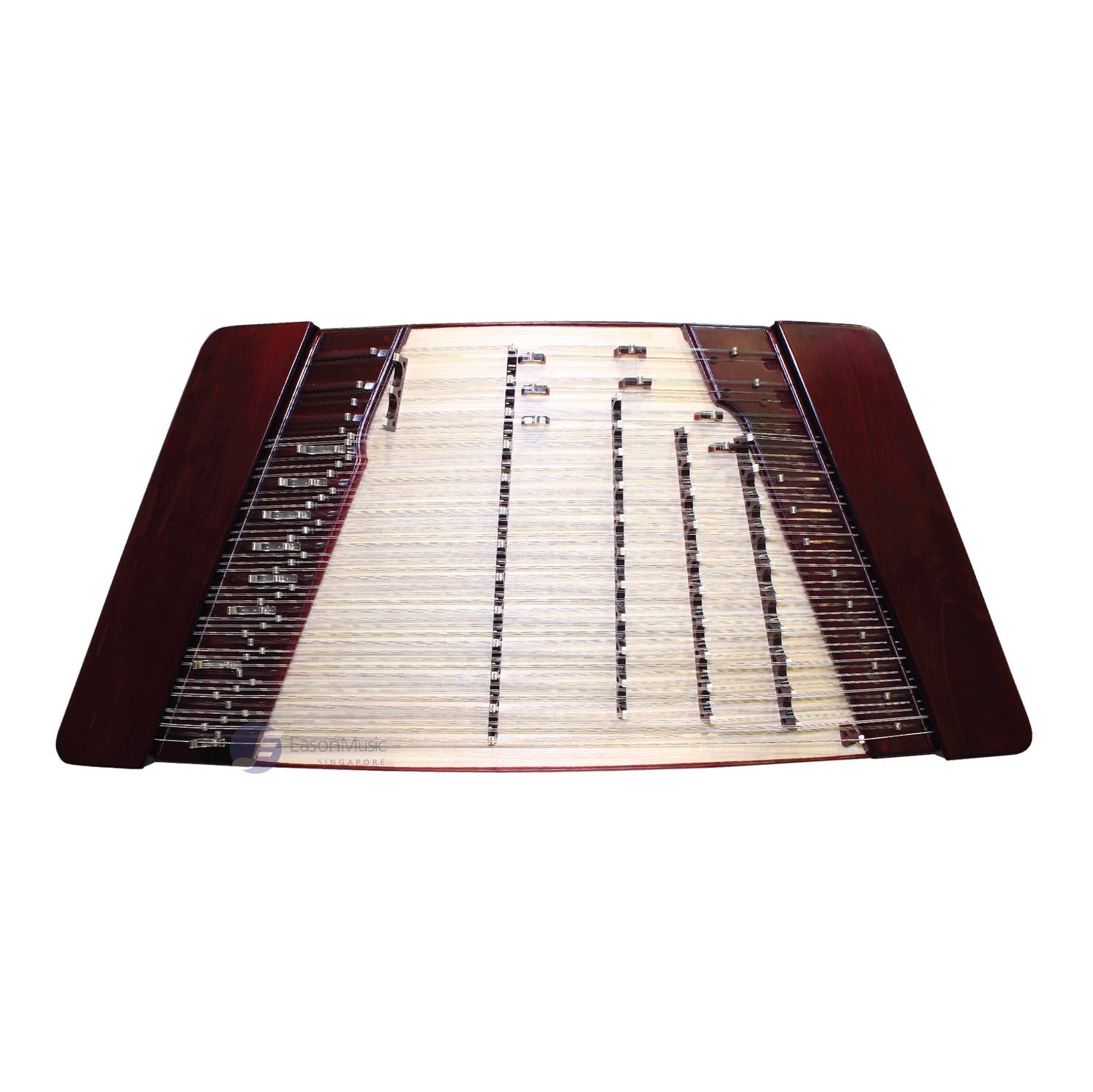
A 402 Yangqin from our store — the standard starting model for most beginners and intermediate players in Singapore.
Brands We Carry
In our experience, Yuehai instruments hold up notably better in Singapore's humid climate — a practical advantage that becomes clear after a year of ownership. Consistently our first recommendation.
One of the oldest Chinese instrument brands. A trusted, consistent maker with a long track record.
A Chaoshan/Guangzhou-based maker with formal collaboration deals with renowned masters Liu Yue Ning (founder of Molly Yangqin) and Li Ling Ling (founder of Diemeng Yangqin). Strong artistic pedigree.
A well-established Beijing-based maker that has long supplied instruments to learners and the general public. Reliable and widely recognised in the Chinese orchestra community.
Unlike the Dizi or Erhu, counterfeit Yangqins are rare — the instrument is niche enough that the fake-goods market hasn't found it worthwhile. However, miniature Yangqins do exist and are sometimes sold without clear labelling. Always check the model description carefully before purchasing online.
How We Test a Yangqin Before It Goes to a Customer
When a new shipment arrives, we don't simply look at the instrument — we play it. Here is what we check:
Scale runs across the full range. We listen for tonal consistency — the character should feel coherent from the lowest bass notes to the highest treble, not warm at the bottom and thin at the top.
High note quality. A good Yangqin produces round, full-bodied high notes. Cheap instruments sound shrill or brittle at the top — a clear sign of poor soundboard resonance or bridge placement.
Bass note support. The low notes should be deep and well-supported — not thin or muddy. We listen for how long the note sustains and whether it has real body behind it.
Physical inspection. We check for cracks at the soundboard and at the corners where wood panels are joined — the stress points most likely to fail. We also verify the bridge sits correctly and is positioned at the right angle for the player's reach.
Keeping Your Yangqin in Good Condition
Singapore's heat and humidity create two main risks: string corrosion and, less commonly, soundboard cracking. Both are preventable with simple habits.
Oil your strings with WD-40 regularly to prevent rust. If you play daily, do this weekly. For an instrument played less frequently, monthly is sufficient. This one habit dramatically extends the life of your strings.
Tuning — A Skill in Itself
Tuning a Yangqin is not a beginner task. The interaction between strings, pin tension, and bridge position means that incorrect tuning can create cascading problems. Our recommendation is to have the instrument tuned professionally — especially in the first year — while you learn the subtleties through observation.
Five Things That Damage a Yangqin Without the Player Realising
These are the most common mistakes we see from new owners — all easily avoided once you know about them.
Moving the fine-tuning rollers. These are not for general tuning — adjusting them incorrectly throws the instrument off in ways that are difficult to correct without expert help.
Tying replacement strings upwards instead of downwards. String direction matters for both tension distribution and tone. Upward ties are a common beginner error that affects playability.
Leaving tuning pins too high. Pins that extend too far above the body will knock against the underside of the cover when it is closed, causing dents and structural damage over time.
Not dusting or cleaning regularly. Dust accumulation between strings and on the soundboard affects resonance and accelerates string corrosion. A soft brush takes thirty seconds and makes a real difference.
Treating the Yangqin as a table. The soundboard is sensitive. Placing objects — or leaning your weight — on the instrument can warp the board, shift bridges, and damage the finish permanently.
Three Questions Worth Asking First
Before choosing a Yangqin, being clear on these three things will point you to the right instrument much faster than any features list.
You don't need the most expensive Yangqin — just the right one for where you are now. Come in and we'll run the sound test with you, answer your questions honestly, and help you decide without pressure.
Come In and Hear It First
We'll run the full sound test with you, match you to the right model and frame wood for your level and budget, and answer any questions honestly.
Browse Yangqins Book a Trial LessonHave questions first? Drop us a message and we'll point you in the right direction.


