

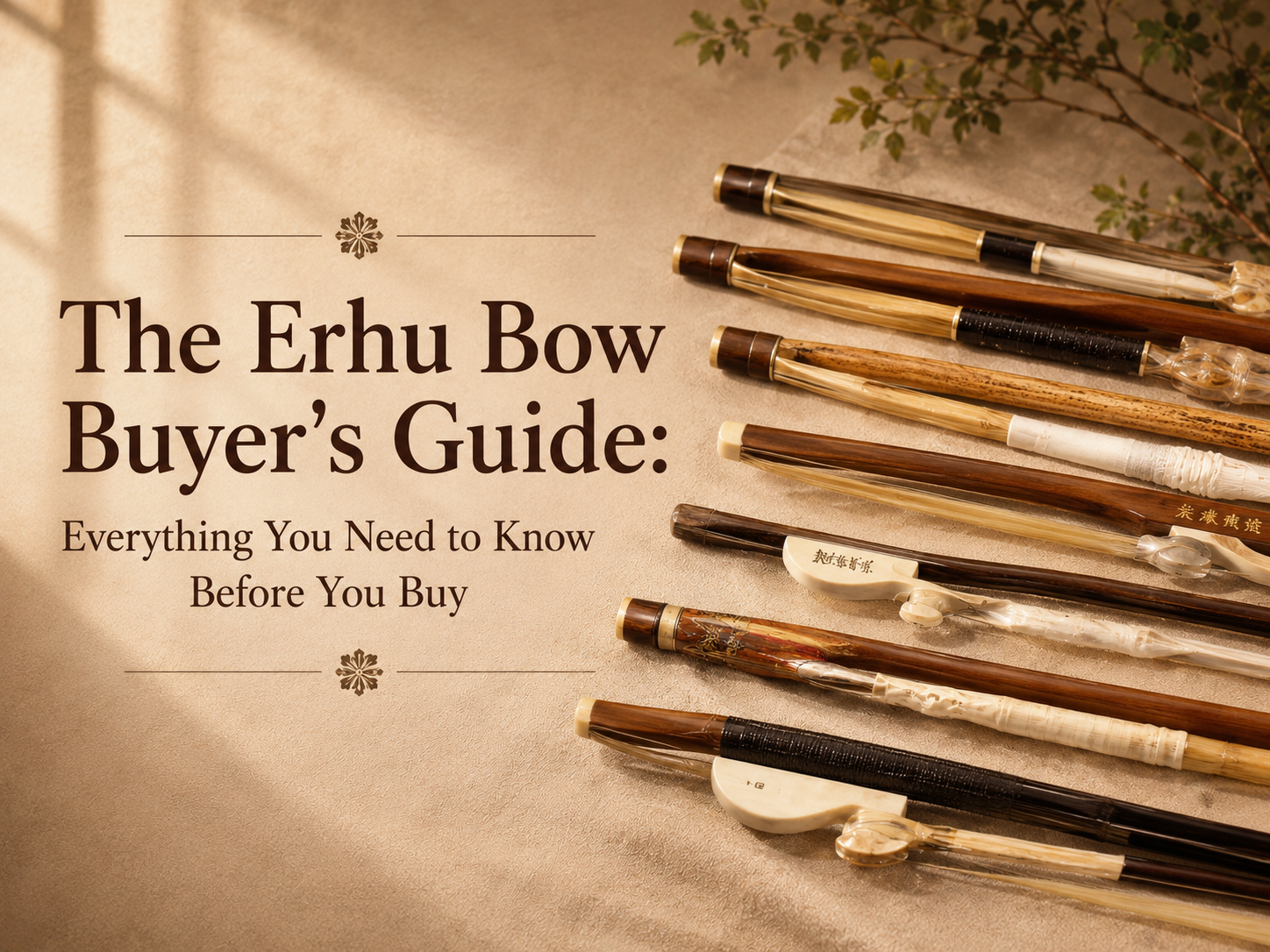
The Erhu Bow:
Shanghai, Beijing,
and Everything
In Between
Most players upgrade their Erhu before their bow. That's often the wrong order. The bow is your voice - it determines how you sound far more than most people realise.
The bow is half the instrument. A mediocre Erhu played with a great bow often sounds better than a fine Erhu played with a poor one. Yet most students spend years upgrading their instrument and never think about what's in their other hand.
This guide covers everything you need to know about Erhu bows - from the fundamental difference between Shanghai and Beijing schools, to which specific bow suits which player, to the small physical details that tell you immediately whether a bow is worth buying.
Why Your Bow Matters More Than You Think
Think of the bow as a microphone and amplifier combined. The Erhu provides the raw material - the resonance, the wood, the skin - but the bow is what extracts and shapes the sound. It determines your tone colour, your dynamic range, your ability to play fast passages cleanly, and how much your instrument sings in slow, lyrical pieces.
The amount, quality, and tension of the bow hair directly shapes whether your Erhu sounds warm and full, or thin and nasal. A bow with insufficient hair simply cannot produce a rich tone - regardless of how expensive your instrument is.
For fast, rhythmic passages - particularly pieces from Northern China - bow stiffness and the design of the frog determine how cleanly notes separate. A bow that is too flexible will blur fast passages no matter how precise your technique.
Even an extra inch of bow length changes how you manage slow passages. Running out of bow mid-phrase forces you to ration - and rationing compromises tone. Weight adds stick to slow bowing, drawing out density without extra pressure.
"We sort of imagined what the results would be like - but it was still quite surprising to hear the bows played side by side on the same Erhu. The difference was immediate and unmistakable."
- Sung Wah, Eason Music · from our bow comparison seriesShanghai vs Beijing - Two Schools, Two Voices
The most important decision in choosing an Erhu bow is understanding the fundamental difference between the two dominant bow-making traditions. Neither is objectively better - they are designed for different tonal ideals and different repertoire.
- Rounder, warmer tone character
- More bow hair - thicker, denser sound
- Heavier stick - sticks to strings in slow passages
- Screw frog - classic, traditional mechanism
- Favoured for lyrical, expressive, traditional repertoire
- Pros who use it: Min Hui Fen, Chen Chun Yuan
- More focused, penetrative tone
- Metal plate clips hair flat - cleaner articulation
- Hook frog - easier to change or adjust hair
- Stiffer stick - more firepower for fast passages
- Favoured for modern, conservatory, Northern China repertoire
- Pros who use it: Yu Hong Mei, Ma Xiang Hua, Yang Xue
This is ultimately a matter of personal preference - not a hierarchy. Some professionals play Shanghai bows their entire career. Others spend years exploring different Beijing bows. The right bow is the one that matches how you want to sound and what you want to play.
Every Bow We Carry - Reviewed
We have compared all of these bows on the same instrument under the same conditions. Here is our honest assessment of each.

All the bows we carry - laid side by side so you can see the differences in stick, frog, and hair at a glance.
Shanghai Bows
The bow that comes bundled with most beginner Erhu purchases. It works well in the early months, but two limitations become clear quickly: it is slightly shorter than a full-length bow, and it has less bow hair - producing a thinner tone that doesn't truly represent what a Shanghai bow can sound like. Think of it as your starting point, not your destination.
This is what a Shanghai bow is supposed to sound like. Longer, heavier, and with significantly more bow hair than the beginner model - the result is a thicker, fuller tone that draws qualities out of your Erhu that didn't seem to exist before. The added weight helps the bow stick to the strings in slow passages, producing a dense, resonant sound without requiring extra pressure. Favoured by Min Hui Fen and Chen Chun Yuan. A genuine step up that most intermediate players feel immediately.
Beijing Bows
A textbook Beijing bow - penetrative tone, stiffer stick, metal plate at the hair tip, and a hook frog that makes adjusting or changing the hair easier than a screw mechanism. Compared directly to the Professional Shanghai, the Wang Xiao Di sounds more focused and cutting, though the tone is slightly thinner in body. It shines in fast, rhythmic passages and pieces requiring strong articulation - particularly Northern Chinese and modern conservatory repertoire.
The same maker and construction as the standard Wang Xiao Di, but built from mottled bamboo (湘妃竹) - a naturally patterned, denser variety that is highly prized by bow makers. The mottled grain isn't just aesthetic: denser bamboo typically produces a stiffer, more responsive stick with better rebound. For players who like the Wang Xiao Di character and want a refined upgrade in the same tradition, this is the natural next step.
The defining feature of this bow is its unbleached horse hair - and it makes a noticeable difference. Unbleached hair has a stronger natural grab on the strings compared to standard bleached hair, giving you more control in slow, sustained passages and a more immediate response when drawing the bow. If you have ever felt your bow sliding or losing grip, this is the one to try.
A top-tier Beijing bow from a respected contemporary maker. Xu Shi bows are known for an exceptional balance between power and refinement - the penetrative character of Beijing school bowing, but with a richness that stops short of the thin, cutting sound lesser Beijing bows can produce. For advanced players who want the Beijing tradition's speed and projection without sacrificing tonal depth, this is worth trying.
A widely respected bow among professionals - used by soloists including Yu Hong Mei, Ma Xiang Hua, and Yang Xue. The stick is not too heavy, yet stiff enough for dramatic expression. What makes it stand out is tone: it produces the penetrative power of a Beijing bow while retaining a richness and body that most Beijing bows sacrifice for speed. We believe this comes down to the exceptional quality of horse hair used. If you are serious about the Erhu and play at an advanced level, this bow is worth trying.

Top: Beijing hook frog - easier to adjust or change the hair Bottom: Shanghai screw frog - tighten or loosen with a turn.
What to Check Before You Buy
Whether buying in-store or online, these are the physical checks that separate a good bow from a disappointing one.
Hold the bow up and sight along the stick from the frog end. It should be perfectly straight - any lateral curve will cause uneven string contact and inconsistent tone across the bow's length.
The screw (or hook, for Beijing bows) should tighten and loosen smoothly with no catching or play. A loose frog that wobbles when drawn is a sign of poor quality hardware.
When correctly tightened, the hair should have some give but not be slack. The hair should form a clean, even ribbon - no bunching or gaps. Too tight risks warping the stick over time.
The stick should feel responsive - not dead. Flex it slightly: a good stick springs back immediately. A stick that feels limp or stays bent has poor bamboo. Mottled bamboo (湘妃竹) is generally denser and more consistent than plain bamboo.
More hair generally means a fuller tone - but evenness matters as much as quantity. The hair should spread into a flat, even ribbon when tightened, with no clumping. Sparse or uneven hair will produce a thin, inconsistent sound regardless of the bow's other qualities.
Which Bow Is Right for You?
If you are not sure where to start, the Professional Single Joint Shanghai or the Wang Xiao Di Beijing Jointless are both versatile, honest bows that suit a wide variety of players at an accessible price. From there, as your playing develops and your preferences become clearer, you'll know which direction to go.
When your bow hair wears out, you may be tempted to seek a rehair service. In Singapore, the cost of a professional rehair is typically equivalent to - or more than - the cost of a new bow at the same level. Our recommendation: replace rather than rehair at beginner and intermediate price points. Reserve rehair for high-end bows where the stick itself is the asset worth preserving.
Rosin - The Bow's Partner
Even the finest bow performs poorly without the right rosin. Rosin creates the friction between hair and string that generates sound - too little and the bow slides silently; too much and the tone becomes scratchy and clogged.
We have covered rosin in detail in a dedicated rosin guide - but the short version: apply a small amount before each session, wipe excess rosin dust from your strings regularly, and match your rosin to your climate. Singapore's humidity means you generally need less rosin than players in drier countries.
We stock a curated selection of Erhu rosins chosen specifically for players in Singapore's climate. Browse at easonmusicstore.com/collections/erhu-rosin →

The bow and rosin work together - getting both right makes a bigger difference than most players expect.
Three Questions Worth Asking First
Before choosing a bow, being clear on these three things will point you in the right direction quickly.
If you're still unsure after reading this, come in and try a few bows on your own instrument. The difference is something you feel as much as hear.
Find Your Bow
Browse our full range of Erhu bows online, or come into the store and try them on your own instrument. Honest advice, no pressure.


