

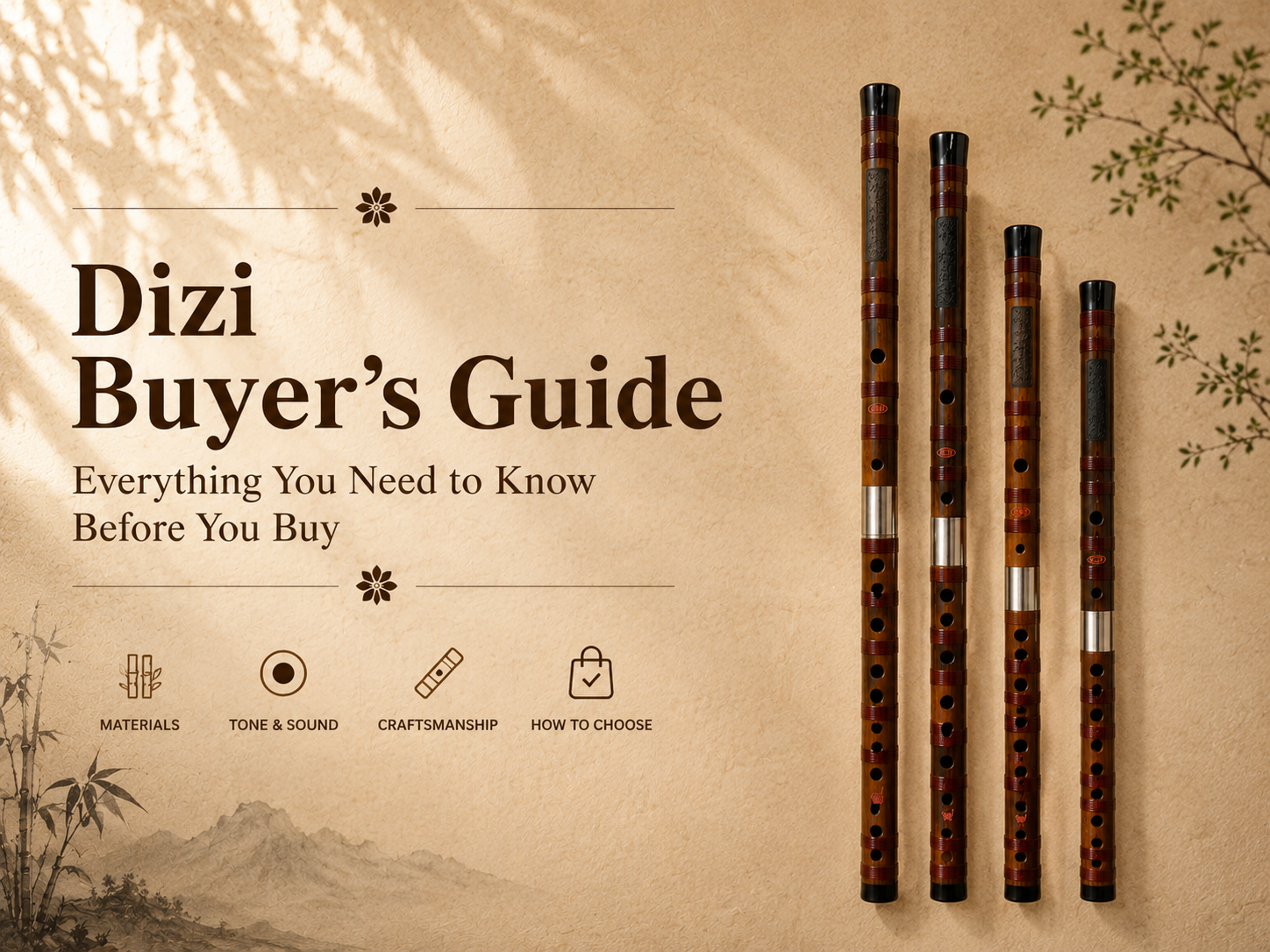
The Dizi Buyer's Guide:
Keys, Bamboo, Makers
& Everything
In Between
The Dizi looks deceptively simple - a bamboo tube with holes. But the key you start on, the bamboo it's made from, and the maker behind it will shape your first year of playing more than almost any other decision.
Of all the Chinese wind instruments, the Dizi is the most immediately accessible - and the easiest to buy wrong. Walk into any music shop in Singapore and you will find Dizis ranging from S$35 to S$1,200. They look almost identical. The difference between them is invisible until you play - and by then, you have already bought.
This guide gives you the knowledge to choose correctly the first time: which key to start on, what bamboo actually matters, which makers we trust and why, and what you need on day one to get your Dizi singing.
Which Key? Start Here Before Anything Else
The Dizi is a transposing instrument - each key is a physically different flute, slightly longer or shorter than the others. Choosing the right key as a beginner makes the early months significantly easier.
We carry the four most common keys for traditional repertoire - C, D, F, and G - plus a range of specialist keys available on order. Here is how they compare:
The most balanced Dizi for beginners. Neither too long nor too short - your fingers won't strain and your breath pressure stays manageable. Most beginner repertoire and Chinese Orchestra entry-level pieces are written for D or G. This is where almost every teacher in Singapore will start you.
Shorter and slightly higher-pitched than the D. Also widely used in beginner repertoire. If your hands are smaller or your teacher recommends it, the G key is an equally valid starting point.
Widely used in intermediate and advanced pieces. Most players add the F key once they are comfortable on D or G.
The longest and lowest of the four standard keys. Requires greater breath support and a wider finger stretch. Not recommended as a starting key - but essential for certain repertoire.
We also carry Low F, Low G, Low B♭, High C, High D, High B♭ and other rarer keys for players with specific repertoire needs. Contact us for details.
Not sure which key your teacher will assign? This set by Xie Bing gives you all four standard keys in one purchase - professional grade quality at a price that makes sense as a complete starting package. Covers beginner and intermediate repertoire from day one.
View the Starter Set →
Arranged from left to right: C, D, F, and G key Dizis. The size difference is immediately visible - the C key is the longest and most physically demanding, while the D and G keys are the standard starting points for beginners.
Bamboo - The Soul of the Dizi
The Dizi's tone lives in its bamboo. Unlike most other Chinese instruments where material type is one of several factors, with the Dizi the bamboo is the instrument - its age, density, and species determine almost everything about how it sounds.
"The most prized Dizi material is white bamboo - a white bamboo grown mainly in Hangzhou. Its tone is distinct: clear, resonant, and versatile enough to respond differently in the hands of different makers."
The traditional gold standard for Dizi making. Produces a clear, resonant, and versatile tone. The most sought-after material among serious students and professionals. Five-year-old white bamboo is considered optimal - the bamboo has matured enough to produce a complex, rich tone that younger bamboo simply cannot replicate.
Darker in colour and denser than white bamboo. Produces a different tonal character - often described as warmer and slightly less bright. A legitimate choice for players who prefer this sound or who are playing contemporary compositions that call for a different tonal colour. Not inferior to white bamboo - simply different.
Less common but a legitimate option for players seeking a distinct tonal palette. Wood Dizis tend toward a rounder, more mellow tone compared to the brightness of white bamboo - useful in certain contemporary and fusion contexts.
Five-year-old white bamboo is the benchmark - but the best bamboo is ultimately the one that produces the sound you want. A contemporary composer may deliberately choose purple bamboo for its tonal colour; a traditional folk player may want the brightest white bamboo available. Neither is wrong.

Left: white bamboo (白竹) - pale gold, clear and resonant. Right: Purple bamboo (紫竹) - dark and dense, with a warmer tonal character. The colour difference tells the story immediately.
Who Makes It - The Three Masters We Carry
At the professional level, the maker matters a great deal. A Dizi from a trusted maker is not just quality-controlled bamboo - it is an instrument tuned note by note, with a specific philosophy of tone behind every decision.
Our primary maker for beginner and intermediate players. Xie Bing's Dizis are known for consistent quality and a wide range - different materials, different bamboo ages, different tone characters - making it easy to find the right instrument at the right price. Whether you are buying your first Dizi at S$68 or a serious student instrument at S$150, the Xie Bing range covers the full span honestly. His starter set of C, D, F and G keys is one of our most recommended purchases for new players.
A well-regarded professional maker known for a rich, dark tone - a sound with depth and complexity that distinguishes itself in both ensemble and solo settings. Each instrument is calibrated note by note. His S$230 model is where most serious players begin; his higher-grade instruments reach collector and soloistic standards.
Where Dong Xue Hua favours richness and depth, Guo Xinming's instruments are known for a bright, resonant tone - equally precise in tuning but with a different tonal personality. His Da Qi line (大漆) is particularly distinctive: traditional lacquer applied to the bamboo creates instruments of exceptional visual beauty - collector's pieces with unique colours and patterns that make each one different. A professional Dizi that is also a work of art.

From left: Xie Bing (beginner–intermediate), Guo Xinming (professional, Da Qi lacquer), Dong Xue Hua (professional, rich dark tone). The craftsmanship difference between student and professional grade is immediately visible.
What Should You Spend? - Price Guide
The Dizi has one of the widest price ranges of any Chinese instrument. Knowing which tier fits your needs helps you find the right instrument without overspending - or getting something that makes the early months harder than they need to be.
Basic instruments. Adequate to find out if the Dizi is for you, but tone and responsiveness are limited. Better suited to a very casual first exploration than serious learning.
Where we recommend most beginners start. Good bamboo quality, honest tone, sufficient responsiveness to make early practice rewarding rather than frustrating.
→ Browse Beginner DizisBetter bamboo age and quality, stronger tone projection. Suitable for grade examinations, ensembles, and committed learners.
→ Browse Intermediate DizisRich dark tone (DXH) or bright resonant tone (GXM). Perfect tuning. Built for performers and collectors. The Da Qi lacquer line reaches S$1,200.
→ Browse Professional DizisA very inexpensive Dizi can be difficult to produce a clean tone from - beginners often assume it is their technique, when it may simply be the instrument. Starting at S$80–S$150 tends to make the first few months significantly more enjoyable and more likely to lead to continued playing.
The Dimo - The "Vocal Cord" of Your Dizi
The dimo (笛膜) is the thin membrane applied over the membrane hole of the Dizi. Without it, the Dizi sounds like an ordinary flute - pleasant enough, but missing the characteristic buzzing resonance that defines the instrument. The dimo is the Dizi sound.
All Dizis are sold without a dimo pre-applied - applying it beforehand risks the membrane breaking during shipping. Every buyer needs to learn to apply one. It sounds daunting; it becomes routine within a few tries.
We have a detailed step-by-step guide at easonmusicschool.com - work through it before your first attempt. Correct dimo tension is one of the most important skills a Dizi player develops.
Which Type of Dimo?
Natural Dimo - Made from the thin inner membrane of reed plant stems. This is the traditional material and produces the most authentic Dizi tone - the characteristic buzzing resonance that defines the instrument. Recommended for all players who want the traditional sound.
Synthetic Dimo - More durable and consistent in thickness than natural dimo. Sufficient for practice purposes, but does not fully reproduce the traditional Dizi tone. A reasonable option for players in environments where natural dimo degrades quickly, but not our first recommendation.
We stock both natural dimo and erjiao (阿胶 - the adhesive for securing the membrane) in-store and online.

Close-up of the dimo applied over the membrane hole. The slight wrinkling is a sign of correct tension - too flat and the tone loses its character; too wrinkled and it sounds scratchy.
What You Need From Day One
The Dizi has a short essential accessories list. You do not need much - but what you do need, you genuinely cannot play without.
Without a properly applied dimo, your Dizi will not produce its characteristic tone. Buy a small packet - they are inexpensive and you will use several in the early weeks as you learn to apply them. We stock these in-store and online.
The adhesive used to secure the dimo to the membrane hole. A small amount is applied around the rim before the membrane is pressed on. Using the wrong glue - or too much - is one of the most common beginner mistakes.
If you plan to carry your Dizi to lessons or rehearsals, a case is essential. Bamboo is vulnerable to knocks and drops. A hard case provides the best protection; a soft bag is the minimum.
Keeping Your Dizi Healthy in Singapore
Singapore's heat and humidity create specific challenges for bamboo instruments. With two simple habits, most problems are completely avoidable.
Moisture is the Dizi's biggest challenge in Singapore. Always store your Dizi in a dry environment - mould can grow inside the bamboo tube if it is kept in damp conditions for extended periods. A cool, dry room with good air circulation is ideal.
Do not leave your Dizi in direct sun - near a window or in a hot car. Sudden, extreme temperature changes cause bamboo fibres to expand and contract rapidly, making the instrument more prone to cracking.
Temperature changes affect pitch. In Singapore, where the gap between an air-conditioned hall (20°C) and outdoor temperatures (30°C+) is significant, a tunable White Copper (Cupronickel) joint lets you adjust pitch to match other instruments. White Copper resists corrosion from our humidity far better than brass - which oxidises quickly and can seize the joint.
Three Questions Worth Asking First
Before choosing a Dizi, being clear on these three things will point you in the right direction much faster than any features list.
You don't need the most expensive Dizi - just the right one for where you are now. Come in and we'll help you find it. No pressure, honest advice.
Find Your Dizi
Browse our full range - from Xie Bing starter sets to Dong Xue Hua professional instruments and Guo Xinming Da Qi collector editions. Honest advice, no pressure.


