

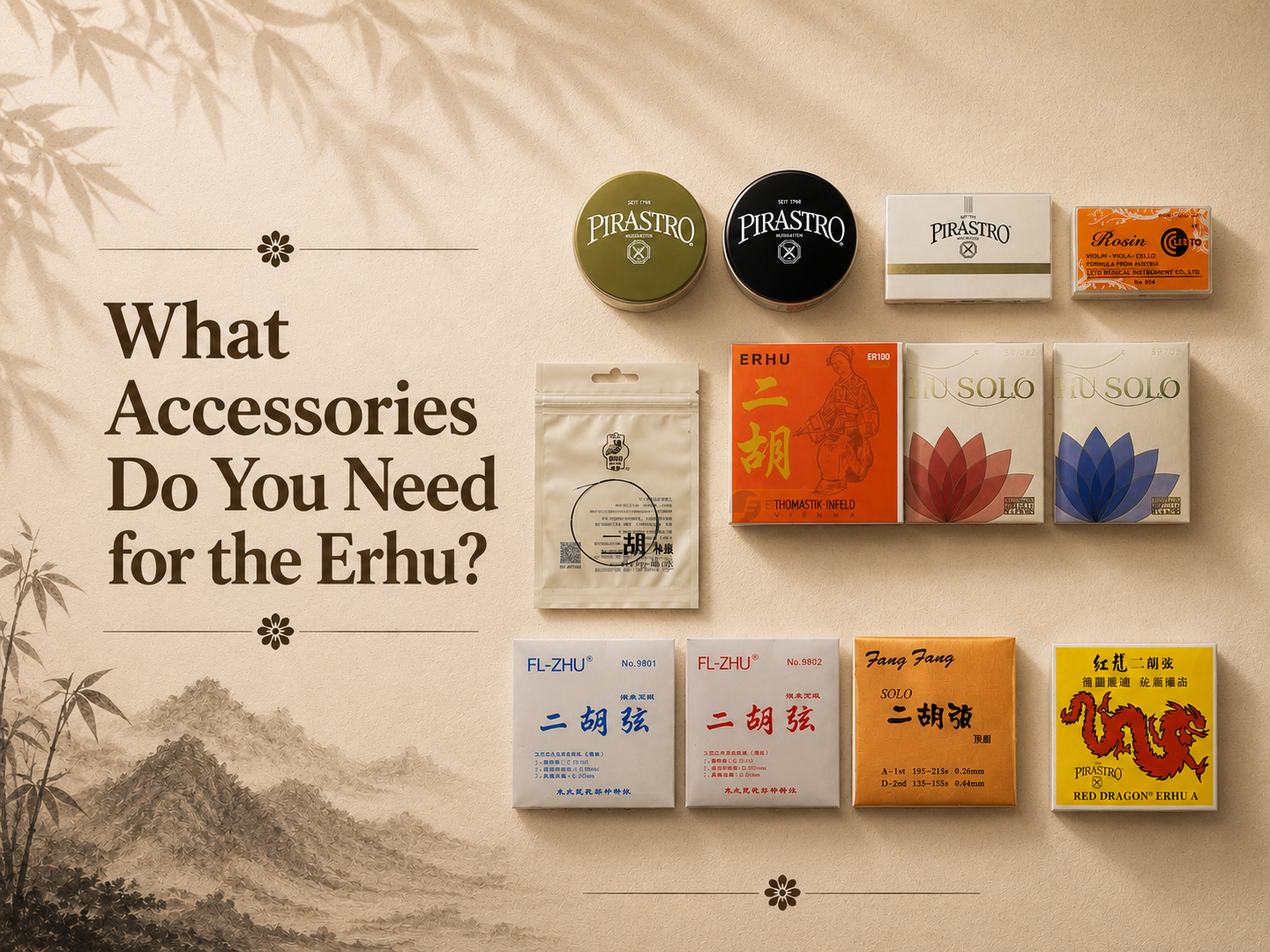
Erhu Strings, Rosin
& Accessories:
What You Actually Need
Once you have your Erhu, the next questions come quickly. Which strings? Which rosin? How often should I change them — and what do I actually need on day one? This guide answers all of it, honestly.
Most Erhu players spend a lot of time thinking about their instrument and much less time thinking about what surrounds it. But strings, rosin, and bow hair all have a direct effect on how your Erhu sounds and how easily it responds — and making the right choices here costs very little compared to upgrading the instrument itself.
This guide covers everything you need to know about Erhu strings, rosin, and accessories. No unnecessary upselling — just honest answers to the questions most players have in their first year.
Erhu Strings — Which Brand and Why It Matters
The Erhu has two strings — an inner string (内弦, nèi xián) and an outer string (外弦, wài xián). They are not interchangeable: each is wound to a specific gauge and tension for its position. String quality affects both tone and how easily the bow can draw a clean sound.

The safest, most consistent choice for most players. Dunhuang strings are widely used across Singapore's Chinese orchestra schools and produce a reliable, honest tone that suits everything from beginner practice to grade examinations. Their quality control is consistent — you know what you are getting.
Two variants worth knowing: the standard Dunhuang string is the go-to for most players; the Dunhuang Nylon-wound variant produces a slightly warmer, rounder tone and is often preferred by players who find standard steel strings too bright or harsh.
A well-regarded alternative with a slightly brighter, more articulate character. Favoured by players who prefer a more cutting tone — particularly useful in ensemble settings where projection matters. A reliable choice for players who already know Dunhuang strings and want to explore a different tonal quality.
A premium string from Pirastro — a German maker known for bowed string instrument accessories. The Wondertone has a richer, more complex tonal character than either Dunhuang or Tianyi, with a warmth and depth that distinguishes itself in solo and recording contexts. Recommended for players with at least two years of experience who have a clear sense of the sound they are looking for.
For regular players (4–5 times per week), changing strings every 6 to 12 months is a reasonable guideline. Strings that have been heavily played lose their resonance — not dramatically, but enough that a fresh set makes a noticeable difference. If your tone sounds dull or the strings show visible discolouration, it is time to change.
"A fresh set of strings on a familiar Erhu often sounds like a different instrument. It is one of the lowest-cost, highest-impact changes a player can make."
Rosin — Small Thing, Real Difference
Without rosin, the bow hair slides across the strings silently. Rosin coats the hair with a slightly sticky surface that grips the string — that grip is what causes the string to vibrate and produce a tone. Different rosins grip differently, and the difference is audible.
We have tested these rosins blind on the same Erhu. Here is what we found.

Came out on top in our blind test. Firm grip, strong tone with real body and projection. If you want more presence and richness from your Erhu, this is where to start. Works especially well with players who use a heavier bow pressure or play in ensemble settings where volume matters.
Slightly less grip than the Oliv — which gives a smoother, more controlled feel. The tone is clean and even without the roughness that heavier rosins can sometimes produce. A good middle-ground choice for most players, especially those who find the Oliv too grippy.
The lightest of the three Pirastro options. Produces a softer, more refined tone — suited to players who prefer finesse over power, or who find heavier rosins make their sound too rough or scratchy. A good starting point for players with a lighter bow technique.
More affordable than the Pirastro range and a reasonable starting point for newer players. The three Leto variants feel broadly similar to each other — decent grip, decent tone. One of our instructors actually prefers Leto over Pirastro, finding the Pirastro options too sticky for their technique. A useful reminder that rosin is personal — the right choice depends on your hands, your bow, and your Erhu.
A light application before each practice session is sufficient for most players. A few strokes across the bow hair — not heavy coating. Over-rosining causes excess powder to accumulate on strings and the snakeskin membrane, dulling the tone and requiring more frequent cleaning. In Singapore's humidity, you generally need less rosin than players in drier climates.
Bow Hair — When to Replace and What to Use
The bow hair on an Erhu bow sits between the strings permanently — unlike a violin bow, it cannot be tightened or loosened. Over time, bow hair wears out: it becomes thin, loses its grip on the strings, and starts to produce a thinner, less responsive tone.
Your bow hair needs replacing when: you notice the bow losing grip despite fresh rosin, the hair looks visibly thin or uneven, or individual hairs are breaking frequently. For regular players, bow hair typically needs replacing every 1 to 2 years.
Replacement vs New Bow
In Singapore, the cost of a professional bow rehair is often comparable to — or exceeds — the cost of a replacement bow at the same level. For beginner and intermediate bows, we generally recommend replacing the bow entirely rather than rehairing. Reserve professional rehair for higher-end bows where the bamboo stick itself is worth preserving.
Standard bow hair is bleached white. Unbleached horse hair — used on our Shi Yun High End Beijing bow — retains stronger natural grip and produces a more immediate bow response. If you have ever felt your bow sliding or losing string contact, unbleached hair is worth trying. See our Erhu bow guide for more detail.
How to Change an Erhu String
Changing an Erhu string is straightforward once you have done it a few times. The most important thing is getting the installation direction correct — an incorrectly tied string will slip under tension and go flat during playing.

Loosen the old string by turning the tuning peg until the tension releases completely. Remove the string from the peg and the anchor point at the base of the instrument.
Thread the new string through the anchor at the base, leaving a small loop. Tie it securely — the standard method is a simple loop-and-lock. Your teacher or a tutorial video will show the correct knot clearly.
Wind the string onto the tuning peg in the correct direction — downward, away from you. Incorrect winding direction is the most common installation error and causes the string to slip flat under playing pressure.
Tune up slowly using a digital tuner. New strings stretch — the pitch will drift flat for the first day or two of playing. Retune before each practice session until the string settles.
The inner string (内弦) and outer string (外弦) are wound to different gauges. Installing them in the wrong positions will throw the instrument's tuning and string tension completely off — and may damage the bridge. Always check the labelling on the string packet before installing.
What You Actually Need — and What You Don't
Here is an honest list of Erhu accessories. Some are essential; others are useful but not urgent. We have kept the list short on purpose.
Essential
Without rosin, your bow produces no sound. Every Erhu purchase from Eason Music includes a starter rosin — but having a spare on hand is worth doing early.
The Erhu is fretless — every note depends on your ear and finger position. A reliable tuner is essential for developing accurate intonation, especially in the first year. A clip-on chromatic tuner or a good app (GStrings, Pano Tuner) both work well.
A dry microfibre cloth for wiping rosin dust off the strings and snakeskin after each practice session. Rosin accumulation on the snakeskin affects tone over time. Thirty seconds after each session is enough.
Erhu strings break occasionally — usually the outer string (外弦), which is under greater tension relative to its diameter. Keeping a spare set on hand means you can replace a broken string immediately rather than waiting for a shop visit.
Useful But Not Urgent
If you travel to lessons or performances, a case protects your Erhu from knocks and temperature changes between air-conditioned and outdoor environments. A padded bag is the minimum for regular transport.
The Erhu rests on the left thigh during playing. A small non-slip mat under the resonator keeps the instrument stable and prevents it from sliding — useful if you practice in trousers or shorts where the instrument tends to move.
If you practice from sheet music regularly, a good stand at the correct height prevents neck strain from looking down at scores on a table. Not urgent in the first few months, but increasingly worthwhile as your repertoire grows.
Keeping Your Erhu Healthy in Singapore
Singapore's heat and humidity create specific challenges for the Erhu — particularly for the snakeskin membrane and the strings. Two simple habits keep most problems away.
Humidity accelerates string corrosion. A quick wipe with a dry cloth after each practice session removes moisture and finger oils — the two main causes of premature string degradation in Singapore's climate.
Moving the Erhu quickly between a cold air-conditioned room and the outdoor heat causes the snakeskin to expand and contract rapidly. Over time, this stresses the membrane. Allow the instrument to acclimatise gradually where possible — especially before playing.
Do not leave your Erhu near a window in direct sun or in a hot car. Prolonged heat exposure can loosen the snakeskin adhesive and damage the lacquer finish on the wood.
Applying a small amount of WD-40 to your strings every week (for daily players) or every month (for occasional players) significantly reduces corrosion in Singapore's humidity. Apply sparingly with a cloth — not directly onto the instrument. This one habit meaningfully extends string life.
Common Pitfalls — and How to Avoid Them
These are the most common issues we see from new Erhu owners. All of them are easy to avoid once you know what to watch for.
Not wiping rosin dust off the snakeskin. Rosin accumulation on the membrane dulls the tone over time. A quick wipe after each session keeps the membrane clean and responsive.
Over-rosining the bow. More rosin does not mean better tone — it means more powder, more mess, and a scratchy, clogged sound. A few light strokes before each session is all you need.
Installing a replacement string in the wrong direction. The string must wind downward around the tuning peg. Upward winding causes the string to slip flat under playing tension. See Section 04 for the correct method.
Swapping the inner and outer strings. Each string is wound to a specific gauge for its position. Installing them in the wrong positions throws the tuning and string tension completely off. Always check the label before installing.
Ignoring the qianjin (千斤) position. The qianjin is the string stop that determines the playing length of your strings. If it shifts, your intonation shifts with it. Check that it sits in the correct position before each practice session — your teacher will show you where.
Three Questions Worth Asking First
Whether you are choosing strings, rosin, or accessories, these three questions will point you to the right choice faster than any product list.
Not sure what you need? Come in and we will help you work it out — no pressure, no unnecessary upselling. We would rather you buy the right thing than the most expensive thing.
Browse Strings, Rosin & Accessories
Everything mentioned in this guide is available in our store. Come in and we will help you find exactly what you need.


