


The Zhongruan
Buyer's Guide:
Woods, Frets & What
Our Experts Listen For
The Zhongruan is one of the most underrated instruments in the Chinese orchestra - rich, warm, and capable of both melody and harmony. Here is everything you need to choose the right one.
Walk into most Chinese music shops and the Zhongruan sits quietly in the corner, overshadowed by the Erhu and Guzheng. That is a shame - because to the musicians who play it, the Zhongruan is irreplaceable. Its round, mellow tone fills the middle register of the orchestra in a way no other instrument can, and its fretted neck makes it one of the few Chinese instruments capable of playing full chords.
This guide gives you the knowledge to choose the right Zhongruan - from understanding what each wood actually sounds like, to the often-overlooked question of steel versus composite frets, to what our specialists are actually listening for when they evaluate an instrument.
What Is a Zhongruan?
The Zhongruan (中阮) is a round-bodied, fretted, four-string plucked lute - the middle member of the Ruan family, sitting between the higher-pitched Xiaoruan and the deep Daruan. In a Chinese orchestra, it occupies the mid-range harmonic role: supporting, enriching, and grounding the ensemble sound.
"The Zhongruan is one of the rare instruments in a Chinese orchestra with a truly mellow and soothing tone. And because of its tuning and range, it can play chords easily - something very few Chinese instruments can do."
- Eason Music Zhongruan SpecialistThat chord-playing ability is what makes the Zhongruan so versatile in modern Chinese music. Jazz voicings, Bossa Nova progressions, pop accompaniments - the Zhongruan handles them all naturally, in a way the Pipa or Erhu cannot. It is also why, in the Modern Chinese Music post we wrote earlier, we called the Zhongruan "the secret weapon" for players who love Western harmony.
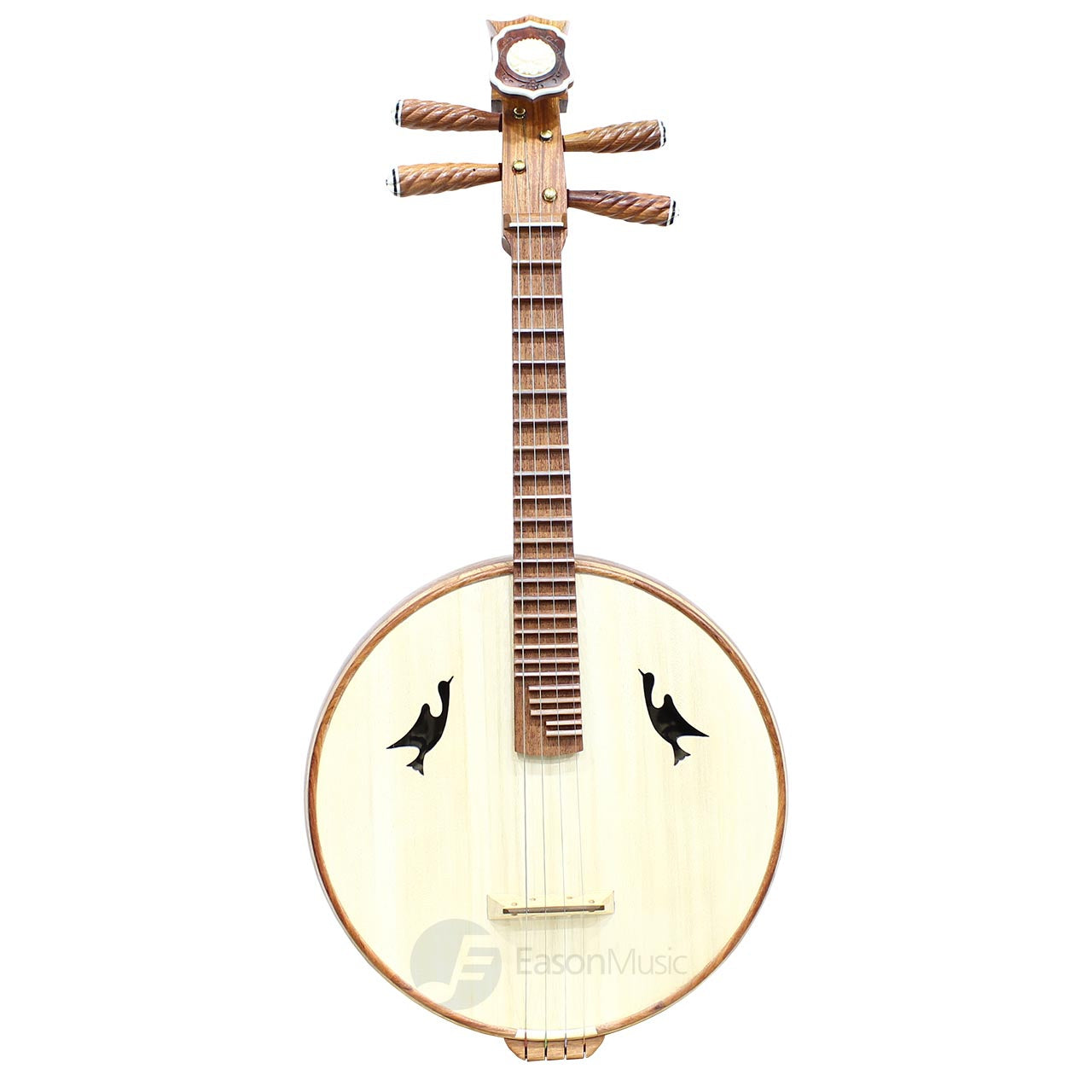
The Zhongruan's distinctive circular body - a full-face view showing the frets, four strings, and round soundhole that sets it apart from every other Chinese instrument.
Back Wood: From Bright to Rich
The wood used for the back and sides of the Zhongruan is the primary quality differentiator between instruments. Here is how our range progresses - from beginner to professional - and what each wood actually sounds like.
A strong, clear tone that is accessible and honest for learners. The projection is more limited than higher-grade woods, but it is more than sufficient for practice and early ensemble playing. A good starting point if budget is a consideration.
Similar strength to basswood, but with a noticeably more mellow and warmer character. Better tonal refinement without a dramatic price jump. A popular first upgrade for students who want more warmth from their instrument.
Produces a bright, powerful tone with excellent projection - the Wenge Zhongruan carries well in ensemble settings and cuts through clearly. If you need an instrument that projects in a large Chinese orchestra, wenge is a strong choice.
A sophisticated step up. Cao Huali produces bright tones with more intricate sound layers than wenge - a complexity that allows the musician to manipulate and shape the tone toward warmth or brightness depending on technique. Comparatively it still leans brighter, but gives the player much more to work with.
The professional standard. Rosewood Zhongruans have mellow, rich tones that are inherently expressive - but also versatile, allowing the musician to shape the sound across a wide tonal range based on technique. Deep enough for solo pieces; refined enough for ensemble work. The painted rosewood variant adds a richer, bassier character at the cost of some projection.
The Liang Hao Painted Rosewood (S$1,600) is a special case. The lacquer painting creates a richer, bassier tone - but slightly limits sound projection compared to a non-painted rosewood. It is also a visual collector's piece. Choose it if you prefer depth and warmth over projection; choose the standard rosewood if you need to carry in a larger ensemble.

From left to right: Basswood - pale, clear, honest entry-level tone; Wenge - dark grain, bright and powerful with excellent projection; Rosewood - rich and mellow, the professional standard.
Steel Frets vs Composite Frets: It Matters More Than You Think
Most buyers focus entirely on wood and price - and completely overlook the fret material. This is a mistake. The type of fret has a direct, audible effect on tone character.
- Brighter overall tone character
- Harmonics sound more easily and clearly
- Crisp note attack
- Better for players who want brightness and clarity
- More mellow tone character
- Rounder, longer aftertone after each note rings
- Warmer note decay
- Better for players who prefer depth and warmth
Neither is objectively better - it comes down to the tone character you prefer. If you are drawn to bright, clear, harmonic-rich playing, go with steel frets. If you want a warmer, more mellow sound with a longer, rounder decay, composite frets are for you. When in doubt, come in for a demo - the difference is immediately audible side by side.
Every Zhongruan We Carry - At a Glance
We stock instruments from Liang Hao (Hebei), Yin Song Lan, Yue Hai, and Song Guang Ning - each with a distinct character and price point. Every instrument is inspected and set up by our team before it leaves the store.
Strong, clear tone. The honest starting point - everything you need to learn proper technique without overcommitting on budget.
Rosewood warmth with the brightness of steel frets. A well-rounded choice at an accessible price from a consistent, reliable maker.
Warmer and more mellow than basswood. A popular first step up for students who want more tonal refinement.
Bright, powerful, excellent projection. For students who need to carry in a larger ensemble or who prefer a brighter tonal character.
Intricate tonal layers, bright with the capacity for warmth. For advanced players who want tonal complexity and flexibility.
Rich, bassy rosewood tone with stunning painted lacquer artwork. Deeper warmth than standard rosewood, slightly less projection. A collector's instrument and a performer's one.
All Zhongruan purchases from Eason Music come with a soft case, pick, and a set of spare strings. Every instrument is inspected, set up, and tuned by our team before it is dispatched.
What Our Specialists Listen and Look For
The Sound Test
Scale accuracy across all frets. We play a full chromatic scale to check whether each fret produces the correct pitch. Inaccurate fret placement is a manufacturing defect that cannot be corrected - it means every note you play will be slightly wrong, permanently.
Ease of harmonics. Clean, easily-sounded harmonics indicate good fret placement and a well-resonating body. If harmonics are difficult or muffled, the instrument's construction is compromised.
Tonal balance across all four strings. Rich bass on the low strings, clear soprano tones on the high strings - and a smooth, even progression between them. Large tonal gaps between strings point to uneven construction or poor setup.
Left-hand comfort at speed. We play fast passages to check whether pressing the frets feels smooth and fluid. A well-set-up Zhongruan should allow fast playing without resistance or discomfort. If the frets catch or the action is too high, technical playing becomes unnecessarily difficult.
Physical Quality Checks
Every fret should be fully and evenly glued down with no lifting at the edges. A fret that is not properly seated will buzz, rattle, or produce dead notes - and is a clear sign of poor manufacturing.
The bridge must be positioned correctly - if the marked placement is inaccurate, the overall pitch of every fret on the instrument will be affected. This is not adjustable after the fact.
Tuning pegs should hold tension without slipping and turn smoothly without catching. Pegs that slip mid-performance, or that require excessive force, are a sign of poor hardware and will make the instrument frustrating to maintain in tune.
Choosing the Right Pick
The pick is your primary point of contact with the strings - and the wrong pick makes playing harder than it needs to be. The Zhongruan pick has two key variables: hardness and shape.
A softer, more pointed tip makes basic plucking techniques easier to execute cleanly - less resistance, more forgiving of imprecise angle. The pointed tip helps beginners find the string cleanly without striking adjacent strings. This is the right starting pick while you are building basic right-hand technique.
As technique matures, a more rounded pick allows greater tonal manipulation - you can shape the tone by varying the angle and pressure of your pick attack in ways a pointed pick cannot replicate. Advanced picks are harder (for better sensitivity and speed) but not excessively so. Critically, they have shaved sides that create a specific angle of contact with the string - this produces a more concentrated, focused tone and gives the advanced player finer control over tonal character.
Every Zhongruan purchase from Eason Music includes a pick suitable for beginners. We also stock a range of picks separately - browse our Zhongruan picks collection as your technique develops.
Keeping Your Zhongruan in Good Condition
Use a dry cloth to wipe down the instrument body and the strings after playing. This removes residual moisture from your hands and reduces the build-up that accelerates string corrosion and surface wear over time.
If leaving your Zhongruan in its case for extended periods, place a desiccant packet or newspaper inside to absorb excess moisture. This is particularly important in Singapore, where humidity inside a sealed case can build up quickly.
Do not leave your Zhongruan in direct sunlight - near a window, in a hot car, or outdoors. Sustained heat and UV exposure can cause the soundboard to crack over time, which is an expensive and sometimes irreparable problem.
The Most Common Beginner Mistake
Dropping the instrument or failing to protect the headstock when travelling. The headstock is the most structurally vulnerable point of the Zhongruan - and headstock breakage is the most common serious damage we see. When travelling with your instrument, especially overseas, wrap the headstock in bubble wrap before placing it in its bag or case. Never place the instrument where it can fall or be knocked over.
Always bubble-wrap the headstock before packing the instrument for travel. The headstock is the first thing to break in any accident - and it is the part most likely to experience impact inside a bag during transit.
Find Your Zhongruan
Browse our full range - from beginner basswood models to concert-grade Cao Huali and painted rosewood instruments. Every piece is set up and tuned before it reaches you.


