


The Guzheng Buyer's Guide:
What You Need to Know
Before You Buy
Size, construction, wood, bridges, nails — every detail shapes how your Guzheng sounds and whether it helps or hinders your learning. This guide covers what actually matters, in plain language.
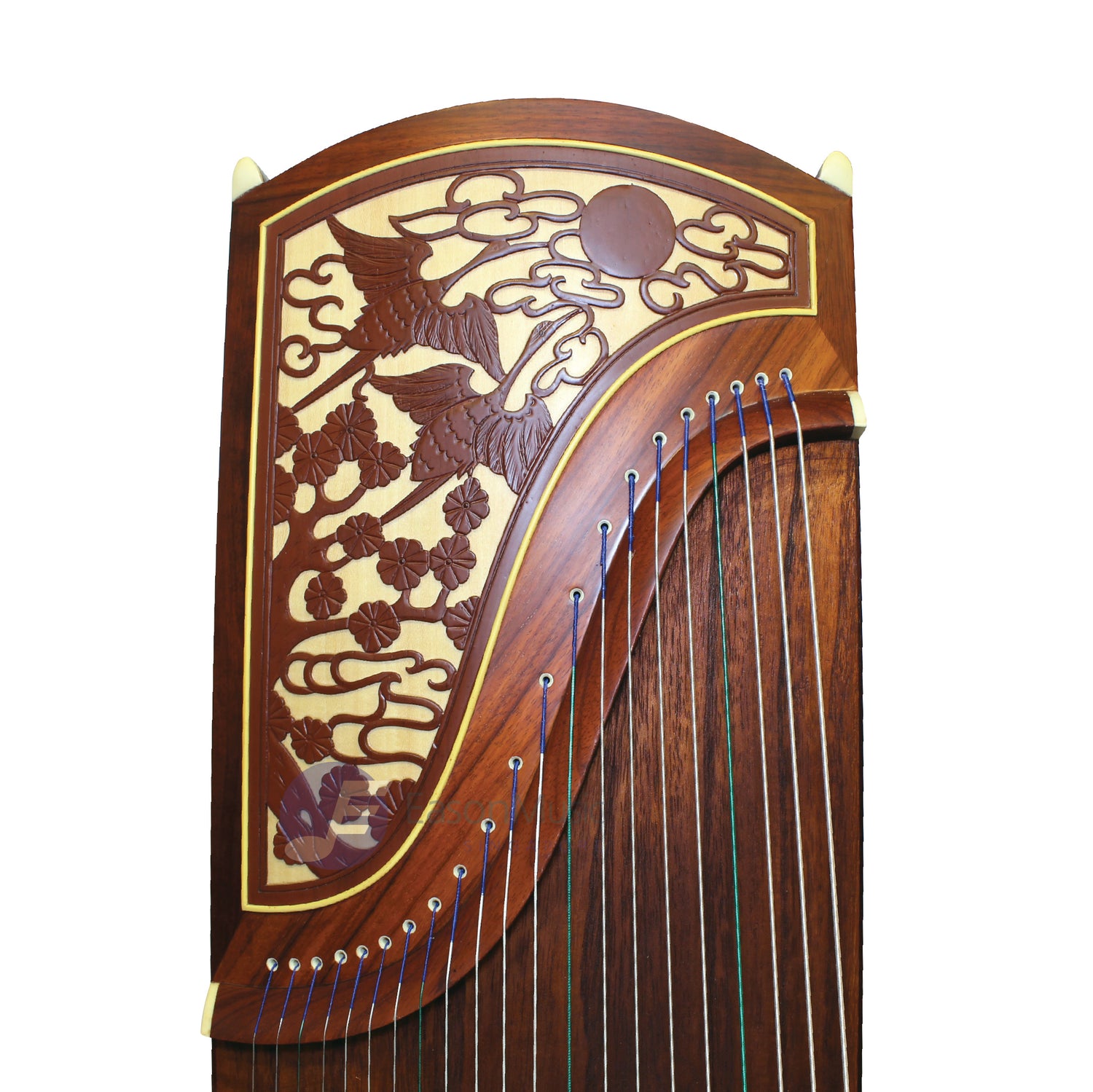
A Guzheng from our store — 163cm, 21 strings, the standard starting model for beginners and serious students in Singapore.
Most first-time Guzheng buyers walk in looking at brand, appearance, decoration, and price — in that order. That's completely understandable: a Guzheng is a beautiful object, and before you have the ear to distinguish tonal qualities, visual impression naturally leads the way.
But the most important decisions — size, construction method, bridge quality, nail type — are invisible to the untrained eye. This guide gives you the knowledge to look past the lacquer and make a decision you won't regret.
Size — Why 163cm Is the Right Starting Point
The standard Guzheng measures 163cm in length. Smaller sizes — 135cm, 120cm, and 100cm — do exist and are marketed for children or compact spaces. We recommend the full 163cm for anyone serious about learning, regardless of age.
Here is why the full 163cm matters:
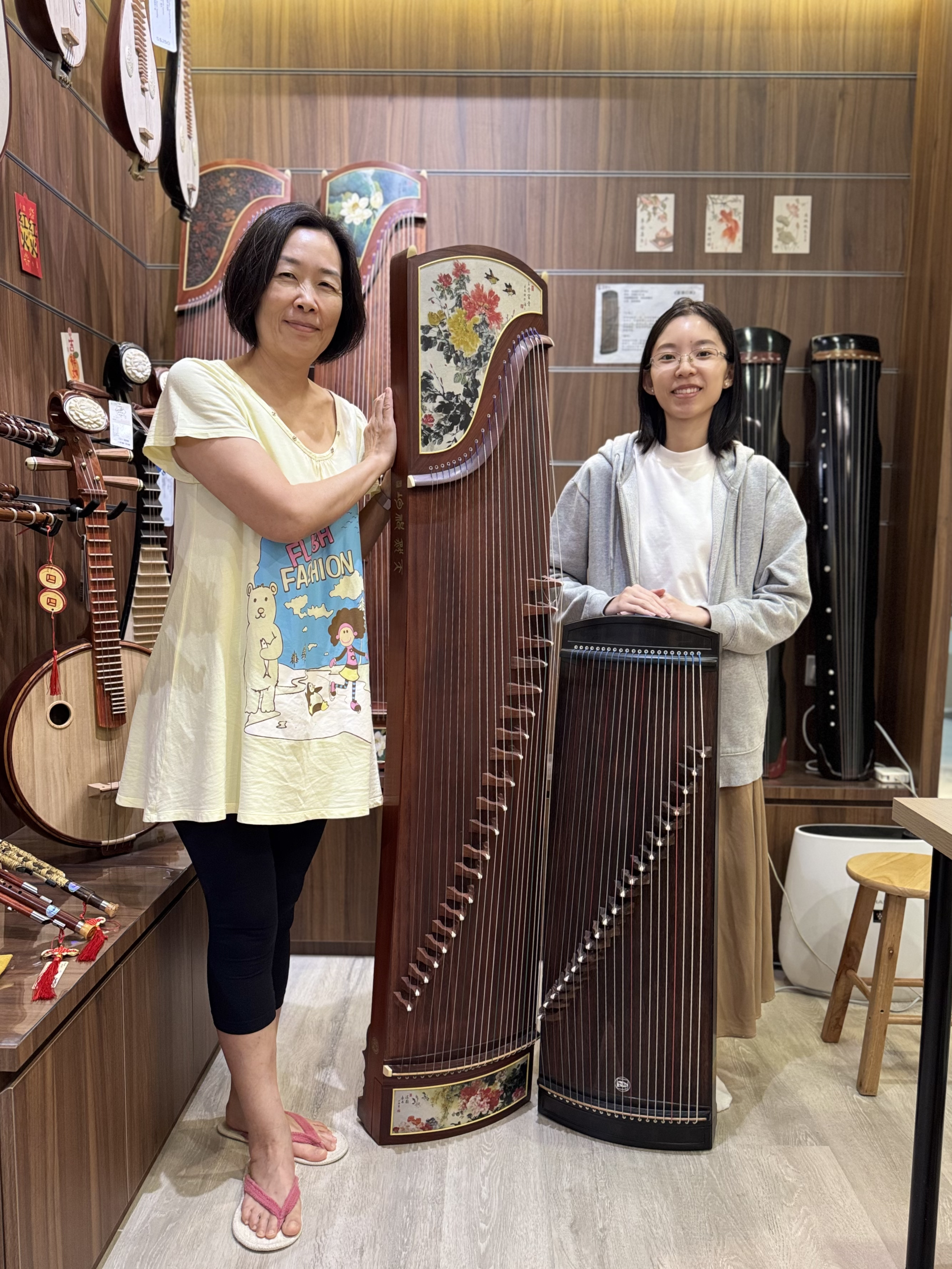
A 163cm Guzheng compared to scale — the standard size for all beginners and serious learners.
Smaller Guzhengs have different string tension from the 163cm standard — which means the finger strength and pressing technique you develop on a small instrument won't transfer correctly to a full-size one. The full 163cm also allows complete resonance, producing a richer, fuller tone that simply isn't possible in a compressed body.
The current universal standard is 21 strings. Traditional regional instruments vary — for example, the Teochew Zheng uses 16 to 18 steel strings. Modern chromatic Guzhengs with 25 or 26 strings also exist, but these are specialist instruments, not beginner choices.
Construction Method — The Detail That Defines Everything
This is the most important quality distinction in a Guzheng — and the one most buyers know least about. There are three manufacturing methods, each with a fundamentally different approach to how the body is built.
The Guzheng is built from individual planks of wood joined together. The soundboard is typically Paulownia across all grades; what changes the price and tone is the wood used for the sides and back. The vast majority of Guzhengs on the market — including the full range of Shanghai Dunhuang instruments we carry — are assembled. At the higher end, a well-made assembled Guzheng can sound exceptional: clear, articulate, and beautifully balanced.
The main body is hollowed from a single thick plank, while other components may still be assembled. The continuous wood grain can produce a different resonance character — often warmer and more open. We carry a small selection of semi-carved Guzhengs for players who prefer this particular tonal quality.
The entire Guzheng is carved from a single thick plank. This produces a distinctive tone — typically warmer and more resonant — but it is a matter of taste, not a straightforward upgrade. Some players find fully-carved instruments too "boomy" compared to a high-quality assembled Guzheng. We do not currently stock fully-carved instruments.
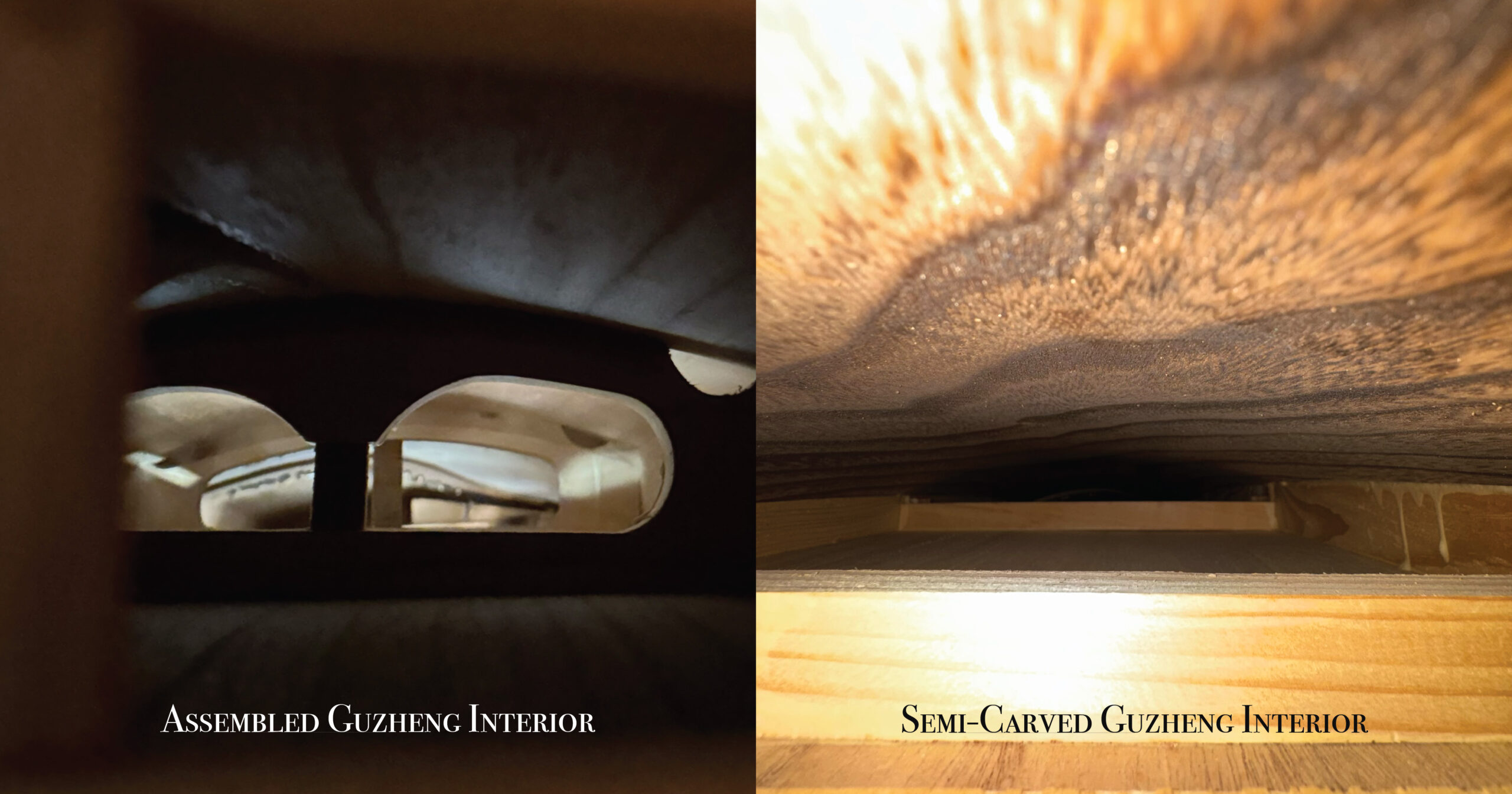
Left: Assembled Guzheng interior — individual planks joined together. Right: Semi-Carved interior — hollowed from a single plank. Construction is a tonal preference, not a quality hierarchy.
Construction method is a tonal preference, not a quality hierarchy. A top-tier Shanghai Dunhuang assembled Guzheng — at the same price as a semi- or fully-carved alternative — can sound comparable or even more articulate. Semi- and fully-carved instruments tend toward a warmer, boomier sound; assembled instruments tend toward clarity and definition. The best Guzheng is the one whose voice suits how you want to play.
The Brand We Trust — Shanghai Dunhuang
Eason Music sells Guzhengs primarily from Shanghai Dunhuang (上海敦煌) — historically the most respected and trusted Guzheng maker in the international Chinese music community. Dunhuang instruments are the standard-bearer at conservatories, competitions, and orchestras across China, Southeast Asia, and beyond.
Brand matters more for Guzheng than for almost any other Chinese instrument — because most first-time buyers cannot yet hear the tonal difference between instruments when they walk in. What they can evaluate is consistency, craftsmanship, and reputation. Dunhuang delivers on all three. Their quality control is among the most rigorous in the industry, which means a Dunhuang at any price tier is a safe, honest choice.
Some small Guzhengs marketed as "practice instruments" have fixed, non-movable bridges — meaning they cannot be properly tuned. These are not suitable for genuine practice and will not serve a student learning correct technique. Always confirm that the bridges (雁柱) are movable before purchasing.
A Simple Price Guide
A good Guzheng is a long-term investment that doesn't become obsolete as you improve. The right instrument is the one that matches your current level, your goals, and your budget honestly.
Assembled construction. Full 163cm. Dunhuang brand. Completely suitable for learning technique from scratch.
Better side and back wood, often semi-carved. Richer tone and better projection for grade examinations and ensemble work.
Semi- or fully-carved construction. Concert-level tone, projection, and tonal consistency. Built for the stage.
The Sound Test — Three Registers and One Final Question
When evaluating a Guzheng, the first question is always the simplest: is there any unwanted noise when I play? A clean, noise-free tone is the baseline. From there, the test moves through three distinct registers — and ends with the quality that defines a great Guzheng above all others.
The high notes should ring out with clarity and brilliance. Harsh, shrill, or thin high notes indicate a poor soundboard or bridge placement.
The middle range should feel well-supported and full-bodied. This is where most melodies live — a weak or hollow midrange will undermine everything you play.
Low notes should have weight and a natural decay — not a thud that dies immediately. The body of the instrument should feel like it's resonating, not just the strings.
How long does the note sing after the string is struck? We test this with mid-to-low notes and techniques like vibrato (颤音) and string bending (揉弦). The lingering resonance is the soul of the instrument's expression.
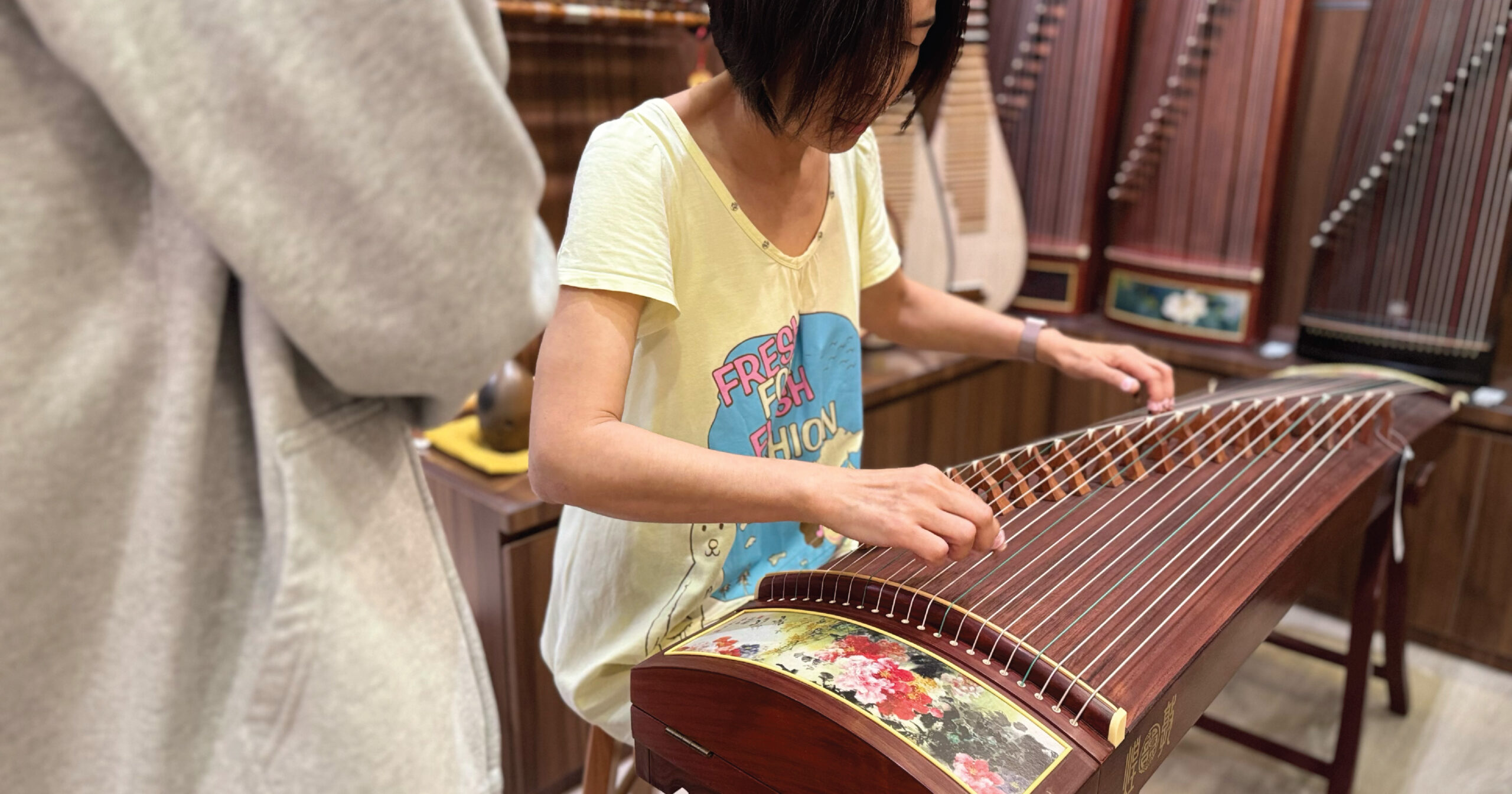
When you come in, we'll play the instrument for you so you can hear the difference — not just read about it.
Physical Quality Checks
What to Look For
Wood grain on the soundboard. Consistent, tight grain indicates a more stable, resonant panel. Irregular or patchy grain can signal inconsistent tone.
Lacquer finish. Should be smooth, even, and free of bubbles or ripples. Fine decorative patterns should be crisp — not blurry or uneven.
String spacing. Strings should be evenly distributed across the bridge line — no crowding or irregular gaps, which would make playing uncomfortable.
Bridge (雁柱) stability and placement. The first bridge should sit approximately 15cm from the front nut, with subsequent bridges in clean decreasing order. When you play, the bridges should not wobble at all. Bridge stability directly determines tone quality. Good bridges are made from rosewood, huali, ebony, or violet sandalwood.
Tuning peg smoothness. Turn each peg — it should rotate with resistance but without catching or stiffness. Pegs that grind or jam will make tuning frustrating and imprecise.
Signs of Poor Craftsmanship
Surface scratches or rough texture. A well-made Guzheng should feel smooth to the touch across all panels.
Visible gaps at joints. Where wood panels meet, the seam should be invisible. Any gap indicates poor gluing or fitting — and a structural vulnerability.
Stiff or uneven tuning pegs. Pegs that don't turn smoothly will make the instrument frustrating to maintain and may damage the string anchors over time.
Wobbling bridges. Any movement in the bridges during playing immediately compromises tone quality and intonation. This is a dealbreaker at any price point.
"Before your ear is trained, your eye leads. But once you know what to look for, you'll never choose by appearance alone."
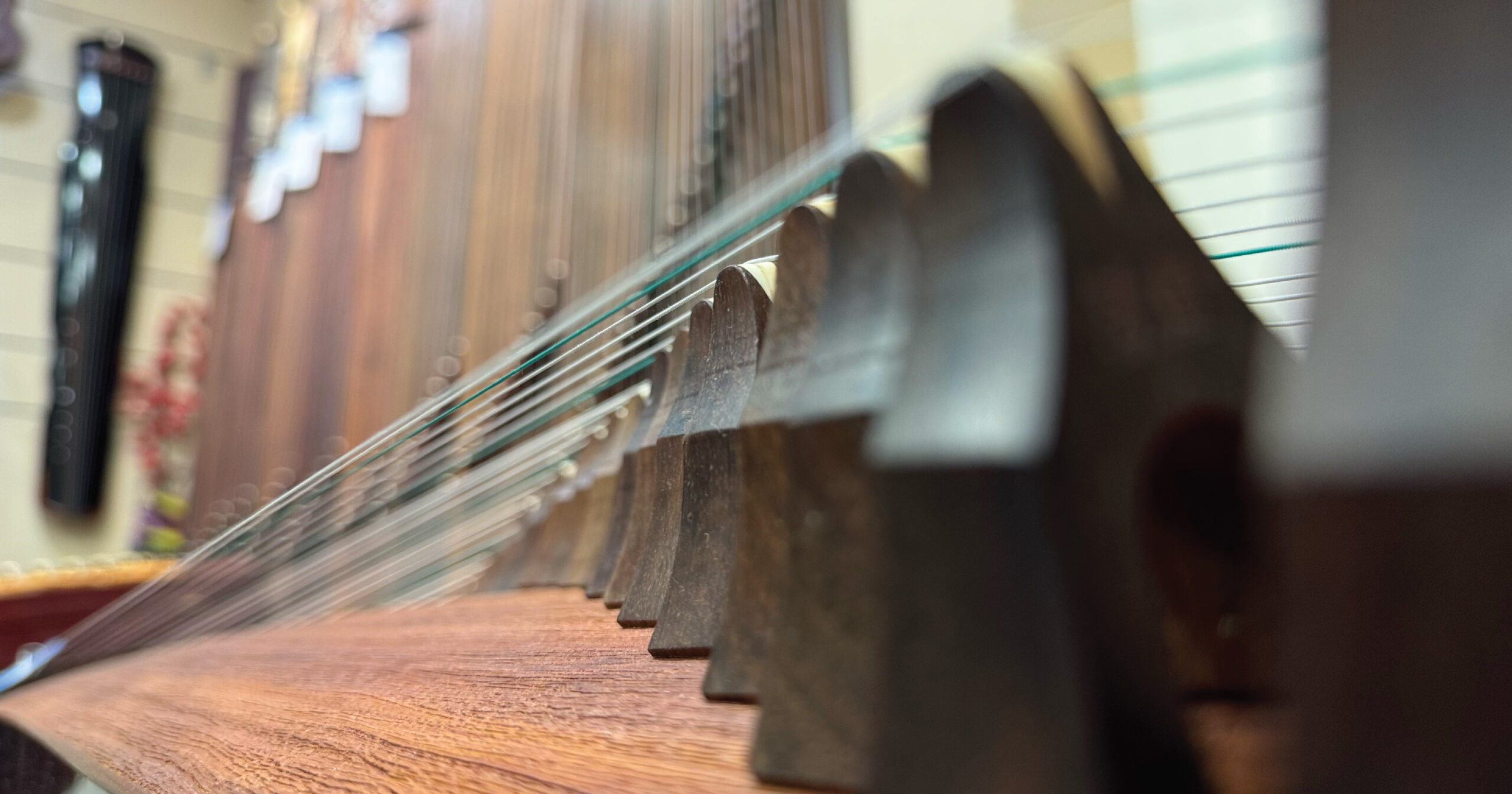
The bridges (雁柱) run along the soundboard in decreasing order. When you play, they should not wobble at all — bridge stability directly determines tone quality and intonation.
Storing Your Guzheng in Singapore
Here is some good news: Singapore's humidity is actually relatively favourable for wooden instruments. In cold, dry countries, instruments crack as moisture is drawn out of the wood. Singapore's ambient humidity keeps the wood stable — well-maintained Guzhengs from 30 to 40 years ago are still in good condition here. Our climate is not the enemy; neglect is.
Two things to be mindful of:
The main risk in Singapore is mould growth from stagnant humidity. Do not leave your Guzheng stored in a sealed bag or closed cabinet for extended periods. Regular air circulation prevents moisture from accumulating on the surface and inside the body.
If you store your Guzheng in a hard case or bag, place a silica gel packet inside to absorb excess moisture. Replace or recharge the packet every few months depending on how often the case is opened.
Unlike players in colder climates who need humidifiers to prevent cracking, Singapore players don't generally need active humidity control. Good air circulation and occasional silica gel use are sufficient for most storage situations.
Guzheng Nails (义甲 Yìjiǎ) — Which Type to Start With
The Guzheng nail is worn on the right hand and is the player's primary contact point with the strings. The material and attachment method directly affect tone, comfort, and how quickly technique develops. This is not a minor accessory — it is a fundamental part of your setup.
Attachment Method
Start with tape-on nails. They are easy to adjust, reposition, and remove — critical while your playing position is still being established. Glue-on nails lock in a fixed position and are for players whose technique is already stable and consistent.
Nail Material
The most practical choice for beginners. Good value, relatively thin, and produces a clean, clear tone for practice. Ideal for building finger independence and basic technique without a high upfront cost.
More durable than resin, with better wear resistance. Well-suited for intensive daily practice and developing finger strength. The tone is slightly warmer and more natural than celluloid.
The finest nail material available. Tortoiseshell produces the warmest, richest tone and has a natural suppleness that responds beautifully to subtle technique nuances. Reserved for advanced players and professional performers.
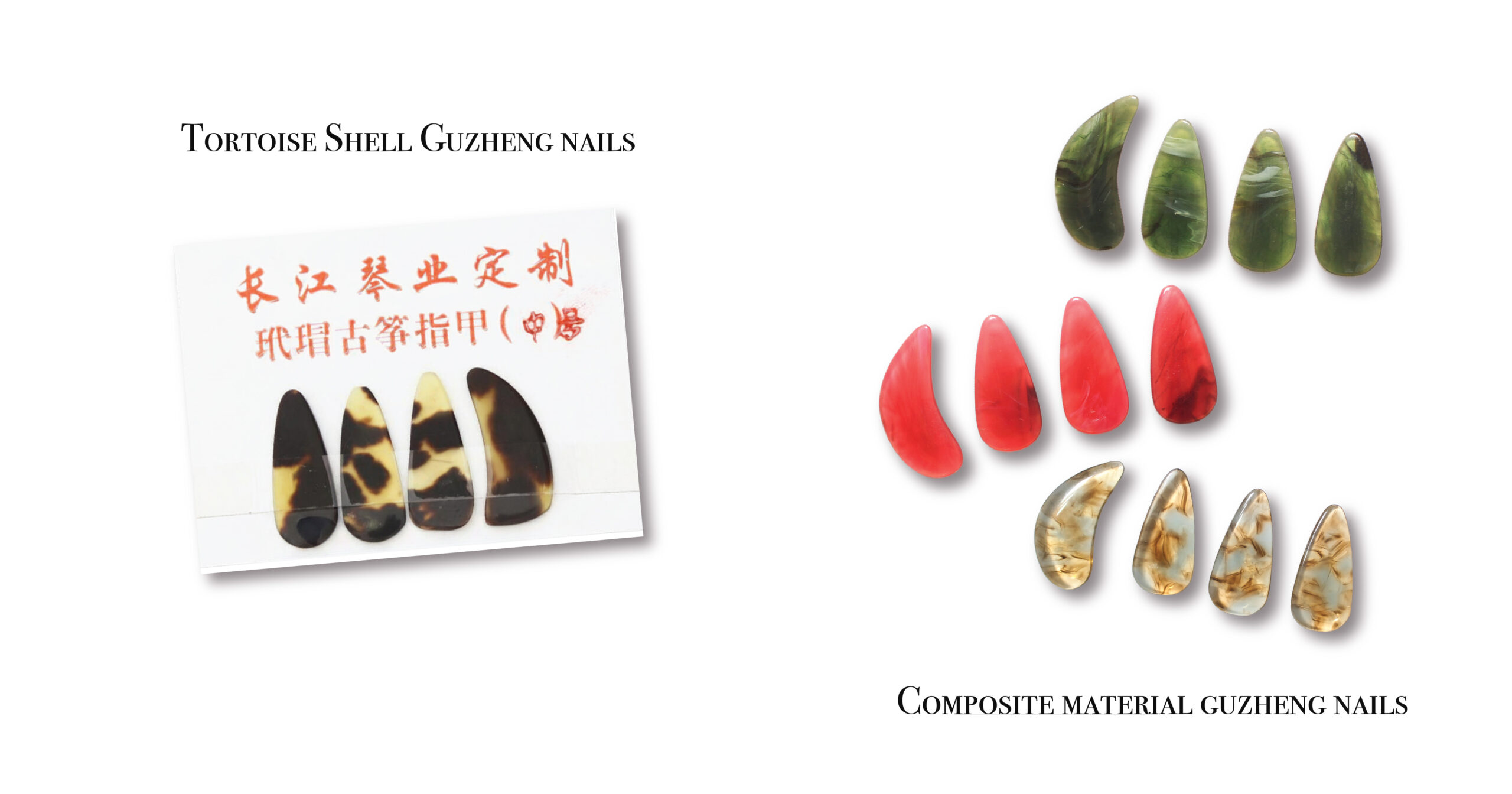
Left: Tortoise shell Guzheng nails (玳瑁) — the finest material, reserved for advanced players. Right: Composite material nails in various types — a practical, durable choice for intermediate players.
A set of nails is typically included with a Guzheng purchase from Eason Music. As you progress, your teacher will guide you toward the nail type that best suits your technique and repertoire. Don't overthink it at the start — tape-on celluloid nails are all you need to begin.
Three Questions Worth Asking First
Before choosing a Guzheng, being clear on these three things will point you in the right direction faster than any features list.
You don't need the most expensive Guzheng — just the right one for where you are now. Come in and we'll listen to a few options with you, answer your questions honestly, and help you decide without pressure.
Come In and Hear the Difference
We'll walk you through construction methods and wood types in person so you can hear — not just read — what the differences actually sound like. Honest advice, no pressure.


