


Erhu Strings:
What Actually
Matters
Eight sets of erhu strings, tested on the same erhu, one week each. What really changes over that week, what your money actually buys, and when to change your strings.
We sell erhu strings. That is exactly why this test was worth doing properly - and why you will find us saying that a S$5.80 set is genuinely good, that the most expensive set is not the best one for everybody, and that the strings already on your erhu may well be fine.
Between 24 July and 17 September 2026 we fitted eight different sets of strings to the same erhu, one week at a time, recording each set the moment it went on and again seven days later. There are also sets waiting in the queue that we do not sell at all. Those will be tested and written up in exactly the same way.
If You Only Read One Part, Read This
Eight sets, arranged by what you are actually trying to achieve. Every one of these is in the test below, with the full reasoning.
Comfortable, loud once settled, and used by professionals. If you are a beginner, this is very likely all you need.
Powerful, resonant and comfortable. This is where quality stops climbing steeply and starts refining.
Balanced and forgiving, and stable from the first day. Nothing to fight.
Loud without being overbearing, and playable straight out of the packet. Time the change carefully.
The brightest of the comfortable sets. Needs its full week before you judge it.
Improves across its first week and looks set to hold. The opposite behaviour to its cheaper sibling.
The whole range runs from S$5.80 to S$38. You can try three different sets for less than fifty dollars - less than we charge for a single good bridge. Strings are the cheapest experiment you can run on your instrument. Please experiment.
One set in this test did not suit our erhu at all. It is below too, and we have not softened it.
An Admission
I have been selling and playing the erhu for decades. It was only through this experiment that I could actually feel the difference between one set of strings and another.
That is an uncomfortable thing to admit in public, but it is the honest reason this page exists. Most players - including experienced ones - never get the chance to try eight sets of strings back to back on the same instrument. You find something that works, and you stay with it. There is nothing wrong with that. But it does mean you are choosing without a comparison.
"A lot of the time, you don't know what you don't know - until you have something to compare against."
- Sung Wah, Eason MusicWhat We Tested On
Everything below was played on one erhu - mine.
It is a Beijing erhu, which is unusual: most of what we sell comes from Shanghai or Suzhou. You can tell an old Beijing erhu from the base plate, which tapers downward rather than upward the way a Shanghai instrument does. It was made by Zuo Wan Sheng, a name the older erhu players will know.
It came to Singapore about thirty years ago with Zhang Lian Sheng, a player with the Beijing Minzu Yuetuan, who was performing here. Visiting musicians often hoped to sell their instrument before flying home rather than carry it back. He approached my father, who founded Eason. My father bought it and gave it to me, because I had just started learning. It has been my erhu ever since.
This is a high-end instrument with thirty-year-old wild skin. Your erhu is probably not this erhu. Strings interact with the wood, with the tension of the skin, and with the maker's work - and different erhus respond differently to the same set.
Everything here is true of this instrument. Treat it as a well-documented starting point, not a verdict on your own.
Eight Sets, Eight Weeks, One Erhu
The point of keeping so much constant is that when something changed, we knew it was the strings and not anything else.
Each session ran the same way. We recorded the outgoing set, changed strings, and recorded the new set within minutes - back to back, so the comparison was immediate rather than remembered. A week later, we recorded that set again and changed to the next one.
Nothing was blind. We knew which strings were on the instrument each time.
Every fresh set was heard immediately after a fully settled one. That means new strings tend to sound harsher by contrast than they would on their own. It is a property of the running order, not always of the string.
All Seven Sets
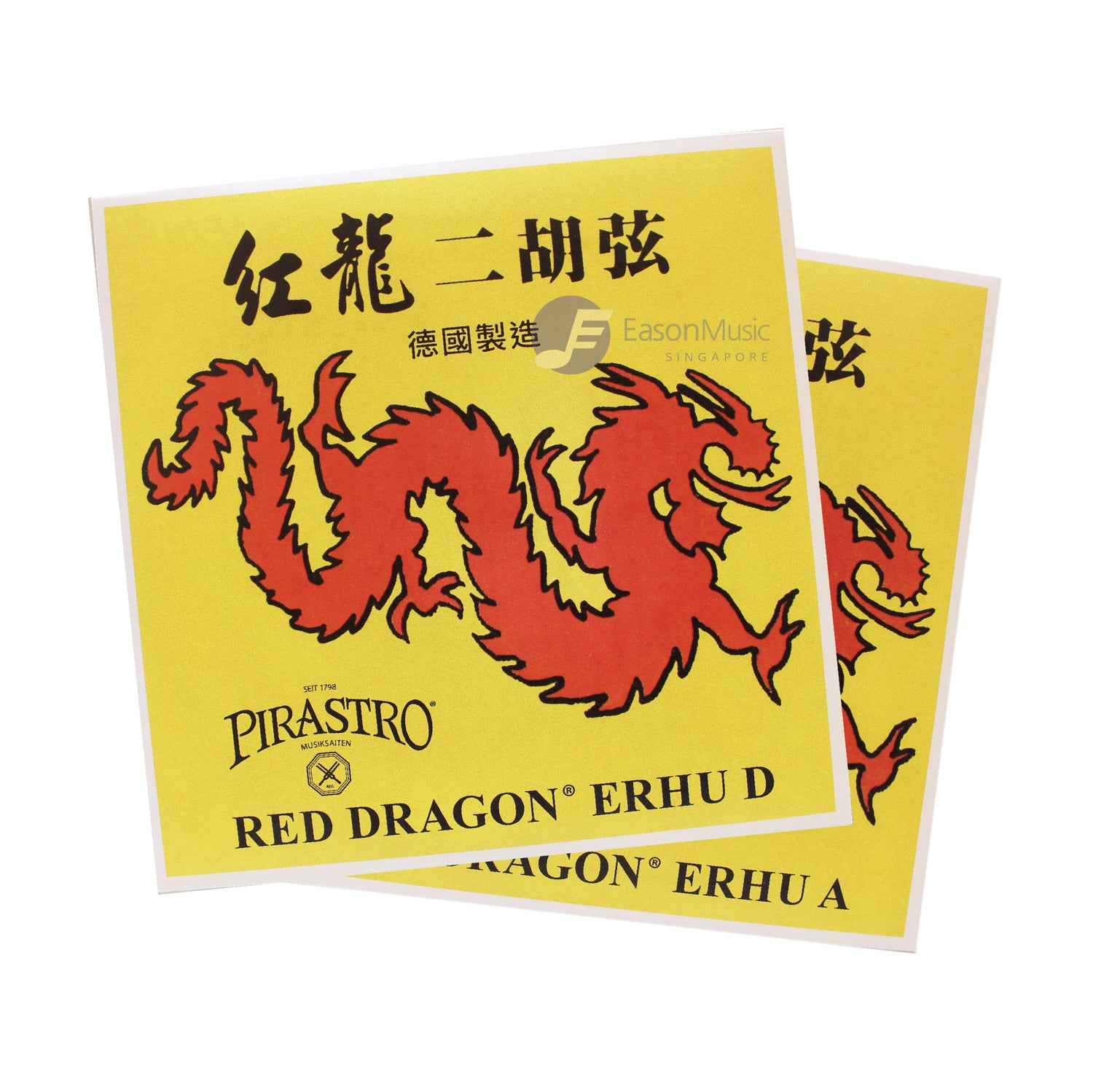
Noticeably louder. Unstable and wobbly, drifting in and out of tune. Harsh and edgy, as you would expect from new strings. Better articulation, and clearer high registers. Robust, bold and strong.
The harshness was gone. Inner and outer balanced in tone and volume, and it rang out more. The high registers projected better than the strings the erhu came to me with.
The brightest and most open of the comfortable sets. It needs its full week - judge these on day one and you will judge them wrongly.
Day 1 · First Impressions
▶ Watch: Pirastro Red Dragon — Day 1 First ImpressionsDay 7 · After a Week
▶ Watch: Pirastro Red Dragon — Day 7 After a Week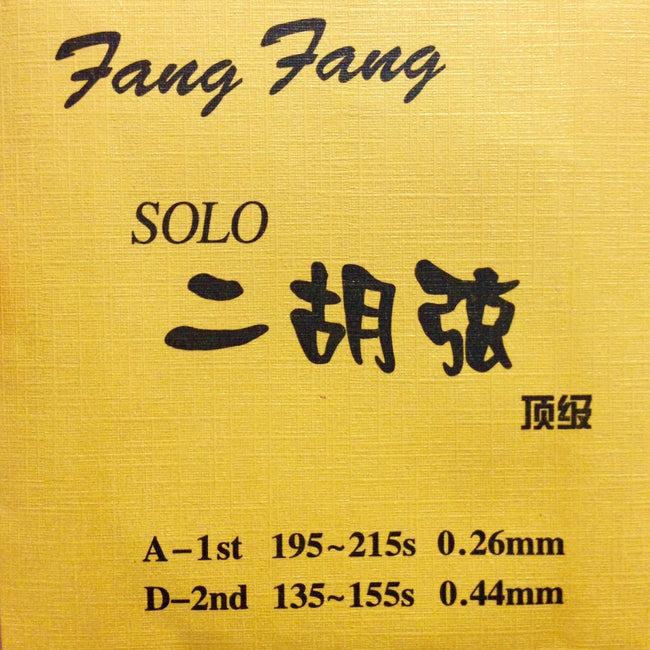
Not as harsh or hard as most new strings. They sounded fine straight away. Less volume than the Red Dragon, and a soft feel under the left hand, which I liked.
Less harsh again, and very well balanced - inner against outer, low register against high, in both tone and volume. Not as open or bright as the Red Dragon.
Clean, warm and forgiving, and stable from the first day. Nothing to fight. This became the set everything else got measured against.
Day 1 · First Impressions
▶ Watch: Fang Fang Soloist — Day 1 First ImpressionsDay 7 · After a Week
▶ Watch: Fang Fang Soloist — Day 7 After a Week
Loud - louder than the Soloist. But not as rich or as focused, with a slight hollowness to the sound.
Good volume, articulate notes, and well balanced between the inner and outer strings and between the low and high registers. Less hollow than at the start, though still not as rich as the Soloist, and a little thin next to it. Comfortable.
More volume than the Soloist for nine dollars less, at the cost of some body.
Day 1 · First Impressions
▶ Watch: Fang Fang Blue — Day 1 First ImpressionsDay 7 · After a Week
▶ Watch: Fang Fang Blue — Day 7 After a Week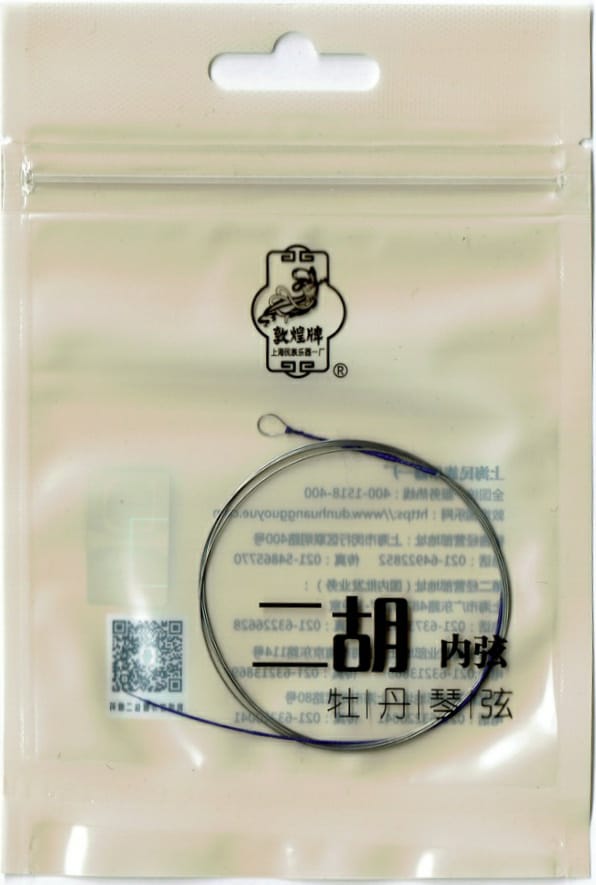
Unstable and wobbly, especially on the inner string. Volume was decent but not remarkable. The tone felt thin.
Very loud, with good volume. A slight edge to the tone - not as warm or clean as the Fang Fang Soloist - and still a little thin. Low tension, comfortable under the left hand.
Basic strings that do the job, and they grew noticeably louder across the week. I know Singapore Chinese Orchestra players who swear by them. A very decent string at a very decent price.
Day 1 · First Impressions
▶ Watch: Mudan Strings — Day 1 First ImpressionsDay 7 · After a Week
▶ Watch: Mudan Strings — Day 7 After a Week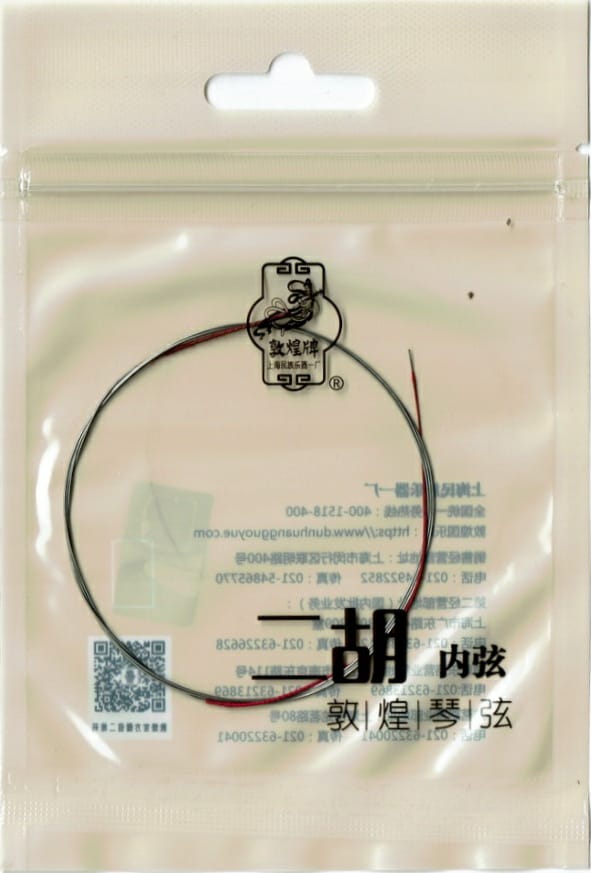
I really did not like these. Very hard, very difficult to play, and harsh. So thick that it felt like putting zhonghu strings on an erhu. The skin and the instrument could not take the tension.
Still brash and harsh, though better than at the start. There was an audible growl on certain notes, mostly on the inner string. Very loud. And because the tension is so high, pushing and pulling the inner string produced noticeably different pitches - fixable by adding a few more rounds to the qianjin, but you need to know that going in.
These stripped out the gentleness and warmth that make a small-leaf sandalwood erhu what it is. They may well suit a different instrument - a heavier one that can carry the tension. They did not suit mine.
Day 1 · First Impressions
▶ Watch: Shanghai Dunhuang — Day 1 First ImpressionsDay 7 · After a Week
▶ Watch: Shanghai Dunhuang — Day 7 After a Week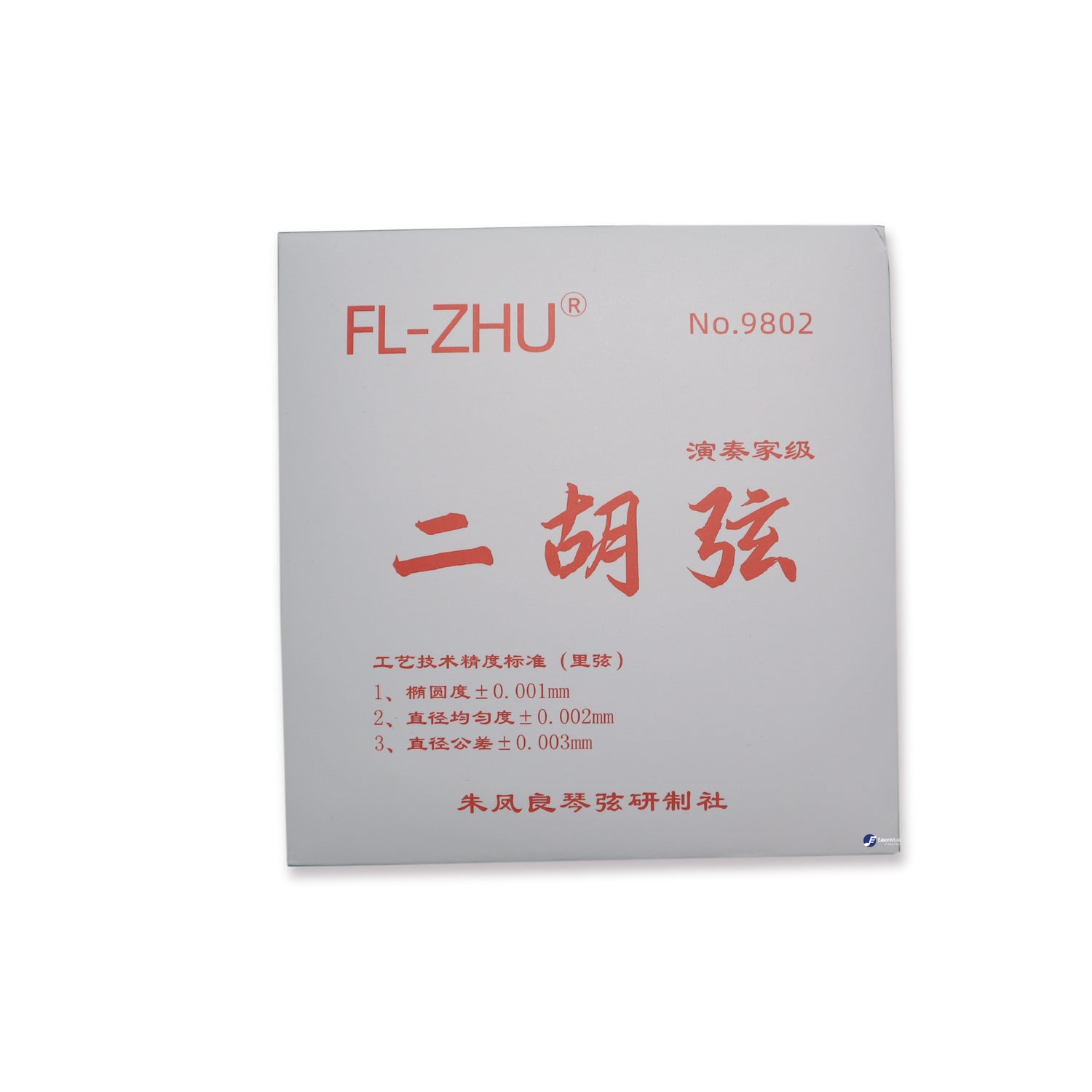
Immediately better than the set before it. Smooth, clean and clear, much like the Blue. Thicker gauge, but still comfortable. A little harshness on the inner string, which I put down to them being new.
Louder than the Blue, slightly richer and more powerful - a more powerful Fang Fang Blue, essentially. Higher tension, but comfortable in a way the Shanghai Dunhuang never was. Not as clean as the Soloist, a touch edgier. I liked the resonance; I could feel the instrument vibrating as I played.
The best value on this page. This is where the quality stops climbing steeply and starts refining.
Day 1 · First Impressions
▶ Watch: Fang Fang Red — Day 1 First ImpressionsDay 7 · After a Week
▶ Watch: Fang Fang Red — Day 7 After a Week
A very good set of strings, straight out of the packet. People say you can use these immediately and I agree. The open inner string was very resonant - I could feel the whole erhu vibrating. Loud, but not overbearingly so. Well balanced across the strings and the registers, with good articulation.
It lost its crunch and its edge - clearly on the outer string, less so on the inner. The outer string warmed up and evened out, to the point where it started to feel like the Fang Fang Soloist. The volume was still there.
The one set in this test that was at its best on day one. With these, when you fit them matters as much as choosing them.
Day 1 · First Impressions
▶ Watch: Thomastik ER100 — Day 1 First ImpressionsDay 7 · After a Week
▶ Watch: Thomastik ER100 — Day 7 After a WeekFour Things Eight Weeks Taught Us
1 · Price tells you almost nothing at the cheap end
The two cheapest sets in this test sit at opposite ends of the quality range. Mudan, at S$5.80, is genuinely good. Shanghai Dunhuang, at S$8.00, was the one set that did not work on this instrument at all. So if you are choosing between budget sets, the price is not the signal.
From about S$13 upward, more money does buy refinement - but not in a straight line. The Fang Fang Red at S$13 is already a set you can be very happy with. Above that you are buying character, not improvement: a brighter sound, a cleaner one, a longer-lasting one.
2 · Two sets from the same maker, moving in opposite directions
Nothing shows this better than the two Thomastik sets. They are eleven dollars apart. One is not better than the other. They do different things.
- At its best the moment it goes on
- Resonant, loud, articulate
- Loses its edge across the first week
- Still good after - just not what it was
- Good on day one, unsettled
- Improves across the first week
- Clear, clean, powerful high notes
- Feels like it will hold that tone
3 · Strings settle on their own - you do not have to play them in
Between recording sessions, this erhu was not played at all. The strings simply sat at pitch for a week.
They still settled. The harshness came off the Red Dragon, the hollowness came out of the Fang Fang Blue, the Mudan grew louder - all without a single bow stroke between sessions.
We did not test whether playing them in is faster, or produces a different result. We only know that not playing them in worked - what these strings needed was to sit under tension at the correct pitch.
4 · Settling in is not always an improvement
This is the finding that surprised us, and it is only visible because every set was recorded twice, a week apart.
Harsh on day one, excellent after a week. The week is essential.
Decent volume on day one, very loud after a week.
Good on day one, better after a week, and it looks like it will hold.
Brutal on day one, merely harsh after a week. Essential, and still not enough.
Excellent on day one, and less exciting after a week. Still a good string. Just not what it was.
The same seven days made most of these strings better and left one of them quieter than its best. If you only ever hear a set on the day you fit it, you are hearing a version that will not last.
When You Change Matters As Much As What You Change To
This follows directly from the point above, and it is the most immediately useful thing on this page - especially if you have a performance coming.
Want maximum punch for a solo? Fit the Thomastik ER100 a few days before - not a week or more, or the edge goes out of it.
Want good tone that holds through a run of concerts? Fit the ERP100 and give it its full week to come up.
Want the Red Dragon at its best? Fit it a full week ahead. On day one it will not sound like the string it becomes.
Performance in a few hours? Not the Shanghai Dunhuang. That would be a very bad decision.
Nothing coming up? Any of the low-tension sets. All of them are comfortable from day one.
When Should You Change Your Strings?
Here is something this test taught us by accident.
Before the first episode, my erhu had a set of Fang Fang Blue on it that I had been playing for months. When I took them off and put on a fresh set, I could hear it immediately: the old strings had gone a bit dead, a bit dull.
But I had been perfectly happy playing them the day before. They sounded fine to me. The decline was so gradual that I had adjusted to it without noticing.
Strings do not fail suddenly. They fade, and your ear follows them down. You are unlikely to notice your strings ageing while you play them - you notice when you hear what a new set sounds like.
Now, the advice you will usually get at this point is that you should therefore change them often. We do not think that is true for most people.
Once a month is the interval most working players we know settle on.
Do the same - about once a month.
Honestly, you can keep a set on until it breaks, or until it starts sounding dull or dead to your own ears. That is a real answer, not a lazy one. Your erhu will not be damaged and your playing will not suffer.
Change them whenever you feel like it.
Knowing that strings fade quietly is not a reason to worry, and it is certainly not a reason to buy more strings than you need. It is so that on the day you do change them and your erhu suddenly sounds alive again, you understand what just happened.
Questions We Get Asked
They need settling, which is not quite the same thing. In this test every set was left tuned to pitch and not played between sessions, and they still changed noticeably over the week. Give a new set a week at pitch before you judge it - with the one exception of the Thomastik ER100, which is at its best immediately.
Some sets in this test were not perfectly balanced between the two strings, so it is a fair question - and several of these are sold as individual strings, not just as sets. We have not tested it yet. It is on the list.
The clearest signal in this test was physical, not tonal. The Shanghai Dunhuang set was simply hard to play, and produced a pitch difference between pushing and pulling the inner string. If a set fights your left hand, or your instrument sounds like it is straining, the tension is probably wrong for it.
Yes. The set that failed here was not a bad set - it was a set that did not suit a small-leaf sandalwood erhu with a thirty-year-old skin. Wood, skin tension and the maker's work all change how a string behaves. Strings can only work with what the instrument gives them.
Two more sets from our own range, and after that we move on to sets we do not sell - strings that were given to us, or bought on a whim years ago and never tried. Those will be written up here in exactly the same way.
Try A Set For Yourself
Every set in this test is in stock, from S$5.80 to S$38. The cheapest experiment you can run on your instrument.


